This is a text version of the notes presented in class.
Feel free to email the instructor (alisonjs@kent.edu) with any
comments about the format and ease of use of these online notes.
1.Lecture 27: Energy from the Oceans
Note: Review for Final exam today-bring your questions-any questions from any material throughout the semester will be welcomed.
I will bring the old exams again-I plan to have them available before and after class today.
1. Marine Resources and Supply and Demand Economics
Resources we are considering today:
Marine Energy Resources (obtaining energy directly from the motion or heat of ocean water, such as tidal energy or thermal energy)
Physical Energy Resouces (petroleum, natural gas, biofuels from algae)
Some of these are Renewable (biofuels, tidal, thermal energy) whereas others are Nonrenewable (petroleum, gas)
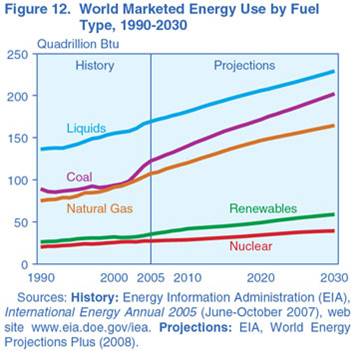
2. Petroleum and Natural Gas- will continue to be the sea's most valuable energy resource
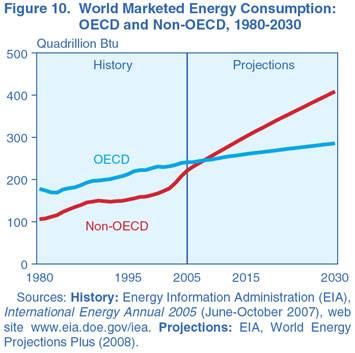
Global demand continues to grow (about 2% per year) for oil (Global usage is 1 cubic mile of oil/year (1 cmo/year))
Projections are that U.S. will increase usage of oil by about 25 % by 2025, China will increase usage of oil by 50% by 2025.
See Figures from Dept. of Energy EIA, www.eia.doe.gov
3. Petroleum in offshore deposits is formed when organic material from phytoplankton is buried and undergoes bacterial decay and also heating from the pressure of overlying sediments. Once these hydrocarbons form and collect, they can migrate to porous sediments and become trapped in reservoirs that can be then drilled. Because temperature and pressure both affect the transformation of organic material to petroleum, there is a hydrocarbon window defined by temperature and pressure beyond which petroleum will not form as useful material. Thus, most offshore oil and natural gas deposits are located in coastal estuarine and shallow continental shelf environments
4. A new source of hydrocarbons found in offshore deposits is methane (CH4) as gas hydrates. These are also found in coastal and shallow continental shelf deposits. Gas Hydrates contain about twice as much carbon as all other fossil fuels (including coal) put together. Gas hydrates are difficult to extract, because if the methane is released too quickly, it can oxidize to carbon dioxide and water. So, this source of energy can be a source of more CO2 to the atmosphere.
5. Renewable resources include hydroelectric (big hydroelectric dams) energy, wind, solar, wave and tidal energy. Today, hydroelectric dams dominate the renewable energy supply. The world is almost at capacity with big hydroelectric dams, and so the growth area is going to be in wind, solar, wave and tidal energy-most of this offshore, where there is room to develop wind and wave farms. Today, only 7 percent of energy supply comes from renewable resources. The goal is to produce 12% by 2030.
6. Coastal areas will receive the greatest impact in future development of renewable AND nonrenewable energy sources.
Time for a Review! Remember, the FINAL EXAM is
Monday May 11 from 7:45 am to 10 am in our classroom in 302 McGilvrey Hall
Covering the entire course, with special emphasis on the section after Exam 3
Style: Multiple Choice & Matching
Number of Questions: Between 65 and 75
Approximately 95% from lecture material
Approximately 5% from readings not covered in lecture
Approximately 40% will be on the old material already covered, and about 60% from the new material since the third exam.
How much does this count? It will count towards
35% of your final grade.
Remember, you can drop one of the 3 midterm grades, but you MUST TAKE THE FINAL EXAM!
You will need to turn in both your scantron answer sheet AND your test to get credit on the exam.
BRING A PENCIL AND AN ERASER!