Lecture 15: Policy III – Some Basics
|
|
Next year's Lake Pleasant
Conference focused on "Fiscal Policy". Representatives of three countries, East, Central, and West
Elmore, were the primary presenters.
In all three countries the unemployment rate was at the natural rate
and the inflation rate was sufficiently low that it was not an issue.
|
|
One question that did arise was
whether there was any role for economic planners from the Central
Banks. Money is, after all,
neutral. While the economists from
the Central Bank were welcome at the conference, it was widely agreed that
the tax and spending questions were primarily questions for the Finance
Ministries. The one exception – and
it was an important one – is that a nation must have healthy financial
institutions to prosper. While
control of the nominal money supply is unimportant in the long run,
maintaining healthy financial institutions is not.
|
|
The planning committee had decided
to open the conference open two background papers. Much of the discussion about fiscal and
tax policies would focus on American experience and institutions. Since members of the audience might not
be familiar with the material, the panel decided to begin with some basic
material on the US economy.
|
Government Spending and Taxes in the United States
|
|
The United States has two levels of
government, each with their own responsibilities. While the line has blurred over the years, there are still
important differences. Most states,
for instance, have Universities, which are state institutions, though many
receive significant funding from the Federal Government. Before World War II combined state and
local government spending was much greater than the federal government. Federal spending greatly increased
during World War II, and dominated the state and local sectors. While state and local spending has grown
significantly since then, it is still less than Federal spending. (State and local purchases of goods and
services are twice that of the Federal Government, but when transfer
payments are included, the Federal Government still dominates).
|
Spending and taxes
|
|
In 1902, the federal government
employed 350,000 people with a budget of 650 million dollars. Today, the government employs over five
million people with a budget of about 1.5 trillion dollars. Until the 1930’s, the federal
government’s role was severely limited.
Since then, it has expanded into a wide range of activities,
including a vastly expanded defense establishment, welfare, social security
programs, minimum wage laws, workplace standards, and massive public
works. Current Federal revenues and
expenses break down as follows:
|
|
|
|
Table 15-1
Federal Revenue and Expenses
|
|
Revenues
|
|
|
Expenditures
|
|
|
Personal Income Taxes
|
48%
|
|
Transfer Payments
|
54%
|
|
Social Security Taxes
|
33%
|
|
Defense
|
16%
|
|
Corporate Income Taxes
|
11%
|
|
Interest
|
15%
|
|
Other (Estate Taxes,
|
8%
|
|
Non-defense
|
15%
|
|
Customs, Federal Reserve
Earnings, etc.)
|
|
|
|
|
State and local
|
|
When we combine state and federal
revenues and expenditures, we get the following picture:
|
|
|
|
Table 15-2
Combined Federal and State Revenue and Expenses
|
|
Revenues
|
|
|
Expenditures
|
|
|
Personal Income Taxes
|
32%
|
|
Transfer Payments
|
42%
|
|
Social Security Taxes
|
20%
|
|
Defense
|
13%
|
|
Property Taxes
|
9%
|
|
Non-defense
|
39%
|
|
Corporate Income Taxes
|
8%
|
|
Interest
|
6%
|
|
Excise Taxes (Including Sales
Taxes)
|
13%
|
|
|
|
|
Other
|
18%
|
|
|
|
The textbook has an excellent
series of graphs showing how spending, both at the federal and at the state
and local level, has changed over time.
You should spend some time studying them.
|
Borrowing
|
|
There are many myths about
government borrowing. We want to
talk later about whether the deficit matters. For the moment, let’s note some key facts. In September 1998, the public debt of
the US was $5.711 trillion. The public held only $3.712 trillion of
that. The other $1.99 trillion was
actually held by the government itself, by the Federal Reserve System, the
Social Security System, the Government Retirement System, etc. This debt is
due to the accumulation of many years of running a government budget
deficit. The deficit is the amount of spending over taxes collected, or in
the present case the surplus is the amount of taxes collected over
spending.
|
|
For most of the period since World
War II, the debt/GDP ratio has been sinking in the United States. It began
to rise around 1980, and has now begun to fall again. Even now, it is back to the level of the
early 1960’s. See Table 15-3.
|
|
|
|
Table 15-3
Privately Held Government Debt as a Percent of GDP
|
|
Year
|
Percent
|
|
1950
|
76%
|
|
1955
|
56%
|
|
1960
|
46%
|
|
1965
|
38%
|
|
1970
|
29%
|
|
1975
|
26%
|
|
1980
|
26%
|
|
1985
|
37%
|
|
1990
|
44%
|
|
1994
|
52%
|
|
1998
|
44%
|
However, these data are
incomplete. Many types of debt are
not included. For example, the
government has promised (quite reasonably) to pay pensions to its
employees. This constitutes an
obligation on the part of the US government of about $1 trillion. The government data on debt do not
include this obligation. Similarly,
the government has promised most citizens social security benefits. Those obligations, which have a present
value of about $4 trillion, are also not included in the official data on
debt.
|
|
Further, when we compare American
Debt to that of other countries, we need to adjust for the failure to
include debt at all levels of government.
Many other countries have a unitary government, where all debt is
the debt of the national government, which is not the case in the United
States.
|
|
Indeed accounting for all of these
debts is complicated. Consider, for
instance, the action of the government of France some years ago, when it
required its citizens to make a loan to the government. Was this forced loan borrowing or was it
taxation? And, when the government
pays back the loan, is this debt reduction or is it a transfer
payment? Thus measures of the
government debt are quite tricky.
|
The Deficits of the 1980’s
|
|
Many Americans think the large
deficits in the 1980’s were caused by huge tax cuts. Yet, as Stockman’s Figure 16-5 shows,
government revenue as a percent of GDP remained relatively constant. What really happened was that government
spending soared, because of the soaring level of transfer payments.
|
The Basics of Taxation
|
|
Most popular discussions of
taxation focus on what economists call the incidence question: who pays the
government’s bills. The discussion
generally focuses on whether the “wealthy” should pay more or less than the
middle class or the poor (though usually most people who engage in this
debate conclude that they are paying too much taxes). There is a limit to what economists can
say about this issue. In terms of
who should bear the burden of taxation, the “scientific” rule was framed
years ago by United States Senator Russell Long (Louisiana), then Chairman
of the Senate Finance Committee:
|
|
|
|
Don’t tax you,
don’t tax me
|
|
Tax the man behind
the tree.
|
|
Self-interest leads all of us to
want someone else to pay the cost of government. There is no scientific basis, for instance, for the common
notion that higher income families should pay a higher percentage of the
taxes. There is a political reason
for this of course: if 20 percent of the families have 40 percent of the
national income, the other 80 percent can –and do – outvote them.
|
Progressive versus Regressive Taxes
|
|
Much
is made of whether taxes should be progressive or regressive. A tax code is progressive if the amount you pay rises faster than your income
and regressive it the amount you
pay rises slower than your income.
For example, If a person with an income of $20,000 a year pays
$2,000 (10%) a year in taxes
|
|
·
The
tax system would be progressive if a person making $100,000 a year paid
more than $10,000 (>10%) a year in taxes.
|
|
·
The
tax system would be regressive in a person making $100,000 a year paid less
than $10,000 (<10%) a year in taxes.
|
|
We have a tax code where some taxes
are regressive and others are progressive.
The Federal income tax, for example, is generally considered an
example of a progressive tax. The
lowest Federal tax rate is 15 percent, and rises to a maximum of 39.6 percent. Other income taxes are not
progressive. Many Ohio cities levy
income taxes as a flat rate on wages; indeed, because these taxes do not
tax income other than wages, they may be regressive.
|
|
The sales tax is generally thought
to be regressive.
|
|
However, there are other issues at
work in regards to progressive taxation, for much effort goes into avoiding
progressive taxation. Most college
professors are, like the rest of the American middle class, taking part of
their compensation in the form of pension plans, designed to defer their
compensation to retirement, when they expect to be in lower tax brackets,
thus defeating the intended progression of the tax rate. To give another example, many corporate
executives take their pay in stock options, taxed at the capital gains rate
of (now) 20%. Thus Michael Eisner,
who gets hundreds of millions of dollars in stock options from Walt Disney,
will end up paying a lower rate on his income than many of you after you
graduate and start working.
|
|
The tradeoff between efficiency and
progression presents another complication.
We will talk later about taxes and incentives, but common sense
tells us that taxes influence behavior.
Here, we make a distinction between marginal and average
tax rates. Suppose, for example, we
didn’t tax the first $20,000 of a person’s income, but taxed income above
$20,000 at a 25% rate. Then a
person making $100,000 a year would pay $20,000 in taxes. His average rate would be 20%, but his
marginal rate would be 25%. Each
additional dollar earned would mean, net of taxes, another seventy-five
cents of net income. Table 15-4
shows some examples. If the
marginal rate were 50%, each additional dollar earned would mean only fifty
cents of net income. Again, common sense tells us that people are more
likely to bestir themselves to earn another dollar if they get to keep
seventy-five cents of that dollar than they are if they only get to keep
half of it.
|
|
|
|
Table 15-4
Average and Marginal Taxes Illustrated
by Marginal Rate of 25% and
$20,000 exemption
|
|
Income
|
Tax
|
Average Rate
|
|
$20,000
|
0
|
0%
|
|
$50,000
|
$7,500
|
15%
|
|
$100,000
|
$20,000
|
20%
|
|
$200,000
|
$45,000
|
22.5%
|
To see what this means, suppose we
make our system progressive by giving people a generous exemption and then
taxing the rest of their income at a flat rate. This is, of course, a variant of the flat tax proposal that
comes up from time to time. But how
big an exemption should there be?
And what should be the marginal rate? These questions are not independent of each other. Consider the data in Table 15-5 on a
hypothetical economy Flatland, and see the choices it faces:
|
|
|
|
Table 15-5
Flatland has total income of $100,000,000. It must finance a government budget of $20,000,000
|
|
If it wants to Exempt the
following amount of income
|
Then its marginal tax rate must be
|
|
$20,000,000
|
25%
|
|
$30,000,000
|
28%
|
|
$40,000,000
|
33%
|
|
$50,000,000
|
40%
|
In short, the more progressive the
system, the higher the marginal rates.
That means reduced incentives.
|
Incidence, both Direct and Indirect
|
|
We should also note that the person
from whom the tax is collected might not ultimately pay the tax. Proposals to levy a tax on (say)
cigarettes usually involve a discussion of whether the producers or the
consumers should pay. In fact, this
is a classic problem in microeconomics: the person who pays the tax directly
may or may not ultimately pay the tax.
For example, if cigarette manufacturers pay $1 a pack in new taxes,
supply and demand conditions will determine how much of that is passed
along to consumers in higher prices.
In fact, many microeconomics textbooks prove the proposition that
the final incidence of the tax will be independent of who pays it. How much consumers pay and how much
manufacturers pay depends on supply and demand, not who writes the check to
the government.
|
|
This incidence question is arising
in current proposals to raise cigarette taxes. Many argue that the manufacturers should pay a higher tax
because of the dangers of the product they sell. Without getting into the merits of taxing cigarettes, the
manufacturers are correct in pointing out that smokers will pay much of the
tax. Moreover, since smokers
typically have low incomes, low-income families, not the stockholders of
tobacco companies, will pay much of the tax burden.
|
|
On top of it, we can not assume that stockholders are
wealthy. Pension plans hold most
common stock. Thus Fred
Truckdriver, the beneficiary of the Teamsters pension plan, may ultimately
pay the taxes paid by stockholders.
|
Minimize the Efficiency Losses of Taxation
|
|
While the incidence question is
interesting and important, there is another side of taxes that we want to
stress in this course: the behavioral
effects. The sad truth is that all
taxes - or virtually all taxes - do affect behavior and we must consider
those effects. A recent request by
Senator Hatfield illustrates the issue.
Hatfield asked the Treasury to study the revenue gain from a 100%
tax on all incomes over $200,000 per year.
The Treasury responded that the government would receive $X billion
the first year and $Y billion per year thereafter. Common sense suggests that while a tax
could perhaps prove very effective the first year, as people were caught
napping, it would have little effect in the years thereafter, and would
raise zero revenue. How many of us would work if we had to give all of our
income to the government?
|
|
The reason for this nonsensical
result is that the Treasury analyzes all tax proposals using static revenue
analysis. They have a data base
built on the dreaded compliance audits.
When asked what a tax would raise, they recomputed tax rates for the
database, without assuming any changes in behavior. While data considerations might drive
them to this task, it is a foolish way to discuss tax policies, although
many people do this.
|
|
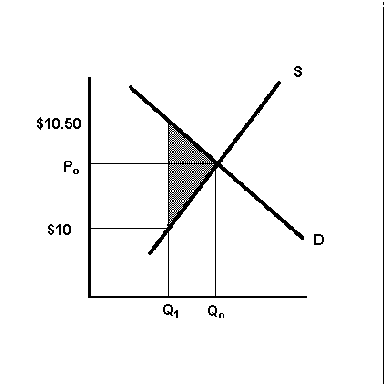
Almost all taxes have efficiency
losses. Figure 15-1 illustrates the
basic proposition. It shows a
demand and supply curve for a particular commodity, with the equilibrium
price at Po and the equilibrium quantity at Qo.
|
|
|
|
|
Figure
15-1
The Distortion of a Tax
|
|
|
|
|
|
|
|
When we impose a tax, so
that (say) the price paid by consumers rises to $10.50, while producers
get $10, there is a distortion or efficiency loss due to forgoing
mutually beneficial trades. The
shading area measures the loss.
|
|
Suppose the government levies a
50-cent tax on the commodity.
People will now move along the demand curve to Q1, where
the difference between the price paid by the consumer and the price
received by the producer is 50 cents.
The consumer is paying $10.50, while the producer is getting only
$10. The shaded area shows the
value of the efficiency loss because it shows the value of the mutually
advantageous trades forgone by suppliers and customers. In advanced courses, we show that the
efficiency loss rises in proportion to the square of the tax rate. Thus, if a 1% tax rate involves an
efficiency loss of (say) $100; a 2% tax rate involves an efficiency loss of
$400; a 3% tax rate involves an efficiency loss of $900, etc.
|
|
Try as you might, there is no
practical way, to avoid this efficiency loss. If we are going to have government, we must have taxes. The government must pay its bills. While there are some theoretical ways of
avoiding the efficiency loss, economists agree that these are only
theoretical possibilities. Ultimately
we have to tax our earnings (which causes efficiency losses from decisions
about working and not working), what we save (which causes efficiency
losses from decisions about saving and not saving), or what we consume
(which causes efficiency losses from decisions about what we consume). We can choose our poison, but we cannot
avoid it.
|
|
Of course, we can minimize the
damage due to the poison. Two
examples will show ways to minimize the efficiency losses of taxation.
|
First Example, Showing the Benefits of Broad Taxes as opposed to narrow
taxes
|
|
Suppose you want to collect $X in
taxes, either by putting a tax on apples or bananas or both. People now spend equal amounts on apples
and bananas, and you know that you can collect the revenue you want with
either a 1% tax on all apple and banana sales, or a 2% tax on apple sales,
or a 2% tax on banana sales.
Suppose also that, after some arduous calculations, we know that the
efficiency losses of a 1% tax on apples and bananas is as given in Table
15-6.
|
|
|
|
Table 15-6
Some Hypothetical Losses from Taxes
|
|
Tax Rate
on Apples
|
Tax Rate
on Bananas
|
Efficiency
Loss from Forgoing Mutually Beneficial Purchases and Sales of Apples
|
Efficiency
Loss from Forgoing Mutually Beneficial Purchases and Sales of Bananas
|
|
1%
|
0%
|
$100
|
0
|
|
0%
|
1%
|
0
|
$100
|
(Many assumptions that go into this
table, but they only simplify the example and do not affect the result.)
|
|
Thanks to our rule that efficiency
losses square every time the rate doubles, we know that we can add some
rows to this table and get Table 15-7.
|
|
|
|
Table 15-7
Some Hypothetical Losses from Taxes
|
|
Tax Rate
on Apples
|
Tax Rate
on Bananas
|
Efficiency
Loss from Forgoing Mutually Beneficial Purchases and Sales of Apples
|
Efficiency
Loss from Forgoing Mutually Beneficial Purchases and Sales of Bananas
|
|
1%
|
0%
|
$100
|
0
|
|
0%
|
1%
|
0
|
$100
|
|
2%
|
0%
|
$400
|
0
|
|
0%
|
2%
|
0
|
$400
|
|
1%
|
1%
|
$100
|
$100
|
While any of the schemes in the
last three rows will do the job, the last approach, equal taxes on apples
and bananas, will minimize the efficiency losses of the tax and in that
sense is the best tax.
|
|
This argument explains why
economists generally prefer broad taxes, rather than concentrated
taxes. Holding the revenue to be
raised constant we would much prefer a sales tax rather than a tax on
apples or bananas alone, for example.
|
|
We still come back to the issue of
who pays the taxes. If I consume apples
but not bananas, I may have a different view of the subject, and tax
debates generally come down to apple lovers squaring off against banana
lovers. But the efficiency aspects
are important.
|
Second Example, showing the advantage of deficit financing
|
|
Now consider another example. The government is going to pay for a
particular project, such as building a road system or fighting a war. The project will cost $X, and can be financed
by a one-year sales tax of two percent.
Alternatively it could be financed in part by a one-percent tax this
year and next. (Or, borrowing could
finance the whole thing). Again, suppose that economists have calculated
the data in Table 15-8 on the efficiency losses
|
|
|
|
Table 15-8
Some Hypothetical Losses from a Sales Tax
|
|
Sales
Tax This Year
|
Sales
Tax Next Year
|
Efficiency
Loss from this year's sales tax
|
Efficiency
loss from next year's sales tax
|
|
1%
|
0%
|
$100
|
0
|
|
0%
|
1%
|
0
|
$100
|
Obviously, the best strategy is to
finance part of the expenditure by borrowing and part by increased taxation,
with the borrowing serving the purpose of spreading the tax burden out over
time. Table 15-9 shows these
calculations. (We spread the burden
over only two years as opposed to three, four, or five, and neglect to
account for interest charges from borrowing to keep the example simple).
|
|
This example explains why
economists favor financing some short term surges in government spending
out of a mixture of taxes and borrowing.
The decision to finance World War II partly through higher taxes and
partly through borrowing was eminently sound. So too is the decision of a municipality building a new
library or police station or fire hall, to finance most of the cost by
borrowing. Borrowing spreads out
the efficiency losses of the higher taxes over time, thus minimizing them.
|
|
|
|
Table 15-9
Some Hypothetical Losses from a Sales Tax
|
|
Sales
Tax This Year
|
Sales
Tax Next Year
|
Efficiency
Loss from this year's sales tax
|
Efficiency
loss from next year's sales tax
|
|
1%
|
0%
|
$100
|
0
|
|
0%
|
1%
|
0
|
$100
|
|
2%
|
0%
|
$400
|
0
|
|
0%
|
2%
|
0
|
$400
|
|
1%
|
1%
|
$100
|
$100
|
The Laffer Curve
|
|
The disincentive effect has an
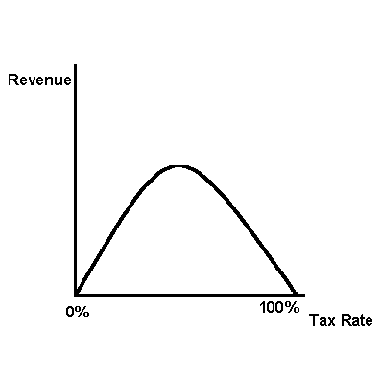
impact on tax revenues received by the government. The Laffer Curve is a way of showing
that higher tax rates do not always lead to higher tax revenue. The Curve, graphed in Figure 12 –2,
plots tax revenue as a function of the tax rate. At a rate of zero percent, zero revenue is collected. As tax rates rise, so does government
revenue. At a rate of 100%, we know
that no one will work and no taxes will be collected. There must be a point that maximizes
total revenues. Any further
increase in the tax rate will cause a reduction in the total revenues
collected by the government.
|
|
|
|
|
Figure
15-2
The Laffer Curve
|
|
|
|
|
|
|
|
It does not take a rocket
scientist to understand that if we tax something at a 0% percent rate, we
get no revenue, and if we tax it at a 100% rate, we get no revenue. Some members of Congress even see this
point. This graph shows how
revenues must then look as a function of the tax rate.
|
|
In the United States, some people
claim that tax rates are above the revenue-maximizing rate. Note that this is not the optimum rate,
just the revenue-maximizing rate.
Most economists doubt this today as a general proposition. (It may be true for some special taxes
such as capital gains). It may have
been true in the past. When
President Kennedy took office, the top marginal rate was 91% and it is hard
not to believe this rate was above the revenue-maximizing rate.
|
|
The Laffer Curve has some important
policy implications. Suppose Congress
cuts tax rates by 15%. Revenues
will not go down by 15%. We will
get some incentive effects so that the tax cut will reduce revenues, but by
less than 15%. In 1996, Bob Dole
proposed a 15% tax cut. His
advisors estimated the tax loss at only two thirds of that and many
economists would find this a reasonable estimate. The idea seems quite simple and straightforward, while one
might argue with the exact numbers.
|
The Effect of Taxes on GDP
|
|
The Laffer Curve is an example of a
general proposition: the impact of taxes on GDP. High taxes depress both
Aggregate Demand and Aggregate Supply.
To see why, suppose the government is running a balanced budget and
suddenly cuts taxes by $100 billion.
What happens? This turns out
to be a complicated and controversial question. It is also an important question, so we will spend some time
on it.
|
The Demand for and Supply of Loans
|
|
As we discussed in an earlier
lecture, there are two views about the effects of the demand and supply of
loans. Without question, the
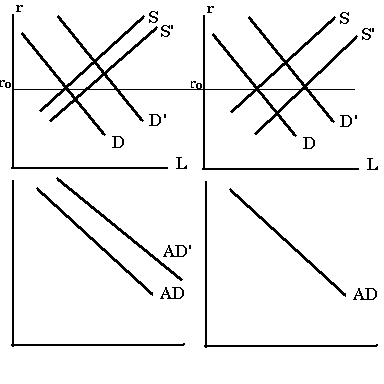
government’s deficit increases the demand for loans by $100 billion from D
to D'. (as shown in figure 15-3)
The debate centers on the effect on the supply of loans. All economists agree that people will
save part of their tax cut, and the supply of loans will shift to the right
from S to S'. Some argue that the
increased supply will be less than $100 billion. Others argue that the increased supply of loans will be
exactly $100 billion.
|
|
One view, shown in the upper
left-hand corner, is that the increase in demand is greater than the
increase in supply. If so, interest
rates rise and aggregate demand increases, as shown in the lower left-hand
panel.
|
|
The other view, sometimes labeled Ricardian Equivalence, is that the increase in the supply of
loans equals the increase in the demand for loans. If so, interest rates remain constant;
aggregate demand does not increase.
The right hand side of Figure 15-3 represents this view.
|
|
|
|
|
Figure
15-3
Deficit Financing, the Loan Market and
Aggregate Demand: Two Views
|
|
|
|
|
|
|
|
This graph illustrates the
two views of deficit financing.
Suppose the government, initially running a balance budget, cuts
taxes and runs a deficit. The
demand for loans increases by the amount of the deficit. There is also an increase in the
supply of loans, for people save at least part of the tax cut.
One view, shown in the
upper left-hand corner, is that the increase in demand is less than the
increase in supply. If so,
interest rates rise and aggregate demand increases, as shown in the lower
left-hand panel.
The other view is that the
increase in supply equals the increase in supply. If so, interest rates remain
constant. Aggregate demand does
not increase. This view is
represented by the right hand side of the graphs
|
|
Impact on Aggregate Demand
|
|
Figure 15-3 also illustrates the
controversy over aggregate demand.
If people save less than $100 billion, the supply of loans increases
by less than $100 billion, and there is not an exact offset to the increase
in the demand for loans. Further,
there is an increase in aggregate demand.
For example, if the supply of loans increases by (say) $90 billion,
then consumption spending is rising by $10 billion, which means a $10
billion increase in aggregate demand.
|
|
Once we know what is happening to
the supply of loans, we know what is happening to aggregate demand. If people save the entire $100 billion,
the supply of loans increases by $100 billion, and there is an exact offset
to the increase in the demand for loans.
Further, there is no increase in aggregate demand. Government spending is not increasing;
and, if there is no increase in consumption spending, then there is no
increase in aggregate demand.
|
Impact on Aggregate Supply
|
|
Whatever the effects on aggregate
demand, there would important implications of this tax cut on aggregate
supply. While this idea, sometimes
called supply side economics,
often gets a derisive review from the press, the basic ideas are
simple. We all know that taxes have
disincentive effects. The higher
our saving is taxed, the less likely we are to save; the higher our labor
income is taxes, the less likely we are to work.
|
|
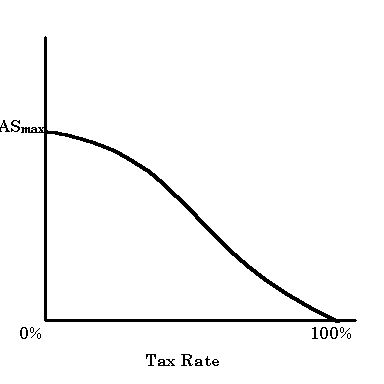
To see the idea, suppose that the
government imposed no taxes, so that there were no disincentive
effects. Aggregate supply would be
ASmax. If the government
imposed a 100% tax on our income, common sense tells us people would not
work, and aggregate supply would drop to zero. Figure 15 –4 shows the relation between aggregate supply and
the tax rate. Of course, as we have
shown there are wise and foolish ways to impose the tax rates to as to
minimize or maximize the impact of taxes on aggregate supply. Further, while we know that the
cumulative effect from extreme taxation is zero aggregate supply,
economists will differ over the shape of the curve. Some suggest that taxes have little
impact until they get very high, while believe the impact comes at a much
lower rate.
|
|
|
Figure
15-4
Aggregate Supply and Taxes
|
|
|
|
|
|
|
|
This graph shows the
relation between aggregate supply and taxes. When there are no taxes, aggregate supply is at its
maximum. As the tax rate
increases, aggregate supply declines.
|
|
Putting the two effects together
|
|
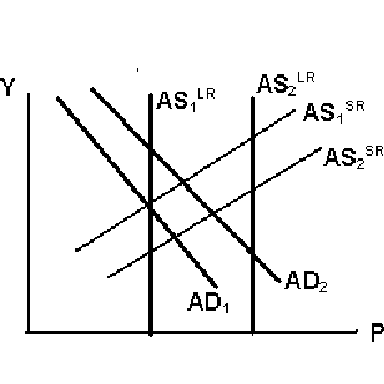
Figure 12-5 combines the two
effects. Cutting taxes while
holding spending constant may or may not increase aggregate demand from AD1
to AD2. It will increase the long-run aggregate
supply curve from AS1LR to AS2LR
and the short run aggregate supply curve from AS1SR
to AS2SR. The
combined effect will be an increase in GDP.
|
|
|
|
|
|
|
Figure
15-5
The Impact of a Tax Cut
|
|
|
|
|
|
|
|
This graph shows the
combined effects on both aggregate demand and aggregate supply curve of a
tax cut. The combined effect is
to increase GDP
|
|
Which one matters?
|
|
This section should really be
entitled "Which one matters the most?" This is a discussion about magnitude.
|
|
Economics is an empirical
science. The ultimate question of
any economic theory is "does it fit the facts". Most economists would agree that a tax
cut has both demand and supply effects.
If you ask which one is the more important effect, you will get
disagreement. To someone who
believes in Ricardian Equivalence, the question is easy: because there are
no demand effects, everything we see must be a supply effect.
|
|
To others, the choice is harder,
and more controversial. Some
economists would argue that while perfect Ricardian Equivalence may not
work, the principle does attenuate the demand effects, so the supply
effects are dominant. Others do not
see the supply effects, and argue that it must be all demand effect.
|
|
It is tempting at this point to
dismiss economists who do not find supply effects. This would be a mistake. There are effects attenuating supply
effects that we have not discussed here. For example, a 50% tax on income
does reduce my after-tax wage, reducing my incentive to work. It also makes me poorer increasing my
incentive to work. Ultimately this
is an empirical issue.
|
|
Both sides in this debate take
ammunition from two recent rounds of tax cuts:
|
|
·
The Kennedy Tax Cuts, proposed by President Kennedy
and enacted by Congress and President Johnson shortly after his
assassination, and
|
|
·
The Reagan Tax Cuts proposed by candidate Ronald
Reagan and carried out by Congress and President Reagan after his election.
|
|
Both involved significant cuts in
tax rates and periods of extensive economic growth followed. Economists disagree on how much of the
boost came from demand growth and how much came from supply growth.
|
|
Our model indicates a problem in
attributing any of this growth to increases in aggregate demand. An increase in GDP due to an increase in
aggregate demand occurs only if we move along a short run aggregate supply
curve. We know that the aggregate
supply curve would rotate. As it
does, any increase due to aggregate demand would disappear. That is, a period of decline in GDP
would follow any growth in GDP due to aggregate demand effects. In fact, the Kennedy and Reagan years
did not presage years of business decline.
Both the Kennedy and Reagan cuts ushered in long periods of economic
growth.
|
Relation to the Text
|
|
Each lecture ends with a section
relating it to the text. In some
cases, material is omitted, either because the text covers it well enough
or because it is not worth learning.
In other cases, material is added.
Each of these “lectures” will end with a brief note relating the
lecture to the text, describing what material is left to the student to
learn alone and what material may safely be skipped.
|
Which Chapters does this lecture cover?
|
|
|
|
Section
from Stockman
|
Coverage
|
|
Chapter 14
|
This lecture covers the parts of
Chapter 14 dealing with taxation.
|
What material is new?
|
|
The discussion of progressive
taxation, and marginal and average tax rates.
|
|
©2000
by Greg Chase and Charles W. Upton.
If you enrolled in Principles of Macroeconomics at Kent State
University, you may print out one copy for use in class. All other rights are reserved.
|