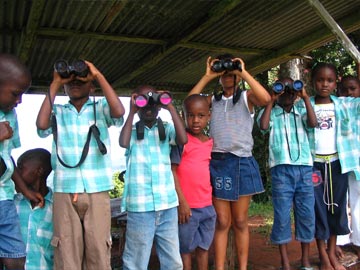
Children at Brownsberg
A group of children visiting Brownsberg Nature Park from
the nearby village of Brownsweg. Photo: Andy McCorkell.


Marilyn A. Norconk
236 Lowry Hall . 330.672.4123
mnorconk@kent.edu

Current Field Research

Brownsberg Nature Park (BNP) (5º 01' N, 55º 34' W) is Suriname’s only national park. It lies 130 km south of the capital city, Paramaribo and consists of a 530 m high lateritic plateau (the Mazaroni Plateau) and the slopes of the mountain extending to sea level at the shore of Lake Brokopondo. The area of the park was recently expanded from 8,400 ha to 12,200 ha (Fitzgerald et al., 2002) and is part of a geological system of forested plateaus in north eastern Suriname. These habitats make up only about 0.5% of Suriname’s land mass (ter Steeg et al., 2000), but may contain several endemic plant species (ter Steeg et al., unpublished). Elevational differences within the park create a variety of forest types.The Mazaroni plateau is very humid due low cloud cover and fog seasonally, with heavy epiphytic growth on the trees and a relatively dense understory. Thin soils on the top of the plateau support primary, secondary, and liana forests. Deeper soils on the slopes support taller trees with a relatively open understory and an abundance of waterfalls draining the upper plateau. Plant families with particularly abundant individuals in the plots included Lecythidaceae, Euphorbiaceae, Arecaceae, Vochysiaceae, and Fabaceae, but most species in the sample were relatively rare, represented by fewer than 10 individuals (Hans ter Steeg, Olaf Banki and colleagues from the National Herbarium of Suriname and Utrecht University in Holland).

With permission and support from the Foundation for Nature Conservation in Suriname (STINASU), Katie MacKinnon (St. Louis University), myself, and students from Suriname and the US have worked at the site since 2003. We have collected baseline feeding data (species, tree dimensions, fruiting abundance, data on fruit handling and physical characteristics of fruit) on primates and birds during both wet and dry seasons. Our research is focused on feeding ecology of white-faced and bearded sakis, and social behavior of white-faced sakis and brown capuchins.

Research by KSU graduate students:

Avis Anzelc: Spatial memory and travel routes used by Pithecia pithecia at Brownsberg Nature Park, Suriname (in progress, 2006).

Tremie Gregory: Exploring male-male competition and cooperation in wild bearded sakis (PhD candidate, 2007).

Delanie Hurst: Social and environmental effects on the vocalizations of white-faced sakis (MA candidate, 2007).

Orin Neal: Antipredator behavior and risk reduction in brown capuchins at Brownsberg Nature Park, Suriname (MA candidate, 2007).

Nick Robl: Feeding ecology and material properties of foods ingested by five sympatric primates species at Brownsberg Naturepark, Suriname (in progress, 2006).

Cynthia Thompson: Sex biases in inter- and intra-group social behavior of wild white-faced saki monkeys (Pithecia pithecia) (PhD Candidate, 2007).

Ari Vreedzaam: Mercury assessment in black spider monkeys (Ateles paniscus): a baseline study for assessing bioaccumilation of mercury in primates living near gold mining areas (MA candidate, 2007).

PDF Map of Brownsberg Nature Park 709KB Click on the thumbnail map to the left to access a high resolution PDF version of the Brownsberg Nature Park map drawn by Evan Bailey, modified from:
Fitzgerald KA, De Dijn BPE, Mitro S. (2002) Brownsberg Nature Park: Ecological Research and Monitoring Program 2001-2006. Paramaribo, Suriname, STINASU.
C.V. | Lago Guri | Brownsberg Nature Park | White-faced Sakis | Diet | Feeding Competition