Capillary electrophoresis (CE), has emerged has a powerful separation technique that can be applied to the separation of a variety of compounds ranging from small drugs to large macromolecules such as proteins. Advantages of CE over other separation techniques are high separation peak efficiency, short analysis times, small sample capacities, low reagent consumption, and low running cost.
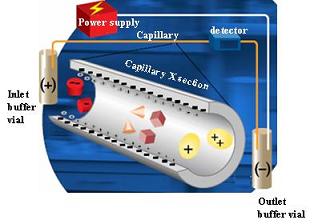 There are many modes of CE including capillary zone electrophoresis (CZE), capillary electrochromatography (CEC), and micellar electrokinetic chromatography (MEKC), all of which can be done using the same instrument. In CZE, the simplest form of CE, separation is based solely on the differences in the electrophoretic mobility between the analytes. No stationary phase is used to assist the separations. In CEC, a stationary phase is used to enhance separations. In MEKC, a micelle-forming compound (pseudostationary phase) is added to the mobile phase to facilitate separation. There are many modes of CE including capillary zone electrophoresis (CZE), capillary electrochromatography (CEC), and micellar electrokinetic chromatography (MEKC), all of which can be done using the same instrument. In CZE, the simplest form of CE, separation is based solely on the differences in the electrophoretic mobility between the analytes. No stationary phase is used to assist the separations. In CEC, a stationary phase is used to enhance separations. In MEKC, a micelle-forming compound (pseudostationary phase) is added to the mobile phase to facilitate separation.
There are two major problems or drawbacks in CE namely:
1. Separation of neutral molecules.
Neutral (uncharged) molecules cannot be separated by CZE. However, in MEKC, the separation media can be manipulated to allow for the separation of neutral as well as the charged compounds. Conventional surfactant micelles e.g., sodium dodecyl sulfate (SDS) have successfully been used in separations of hydrophilic and slightly hydrophobic analytes. However, organic modifiers are usually added to the buffer system for separation of highly hydrophobic analytes such as polycyclic aromatic hydrocarbons (PAHs) and some proteins and lipids. High organic modifier concentrations tend to disrupt the conventional micelles and eventually have an adverse effect on the separation.
2. Uncoated inner capillary surface.
The use of uncoated silica surfaces presents a major problem for some CE separations. For example, the separation of proteins remains a challenge in CE due to strong electrostatic interactions between the negatively charged silica wall and the analyte. This adsorption problem often leads to a decrease in peak efficiency, poor peak and elution time reproducibility and, instability of the baseline. In some extreme cases, protein recovery is impossible as a result of adsorption on the capillary surface.
Another problem associated with the use of uncoated silica capillaries or uncoated microchip channels is the lack of control over the magnitude and direction of the electroosmotic flow (EOF). In CE the EOF could be considered as an "electrically-driven pump" which creates a plug flow that effectively sweeps solute ions along the capillary generally towards the detector as compared to a pressure pump in HPLC which creates a hydrodynamic flow which pushes the analytes to the detector. The magnitude and direction of the EOF are determined by the surface charge of the capillary or separation channel, making the control of the surface chemistry an important variable. A number of coatings (covalent and dynamic) have been developed to reduce the problems associated with unmodified silica surfaces. Covalent coatings are very robust but their preparation procedures are tedious and often require the use of extreme conditions. Dynamic coatings are simple to prepare but they are less stable. For dynamic coatings, the coating material must be present in the mobile phase during the separation and can interfere with mass spectrometric detection of the analyte.
Our research seeks to solve the problems associated with the separation of neutral molecules and highly hrophobic analytes such as lipids involved in cell signalling, enviromental pollutants such as PAHs, and fatty acid esters common in biodiesel fuels. One approach towards this goal is investigating how common surfactants, polymers, and metal cations can be combined to provided excellent separation of the above mentioned molecules. Another approach is through the synthesis of novel molecular micelles that can be used in place of the conventional surfactants to achieve excellent separations. In addition, some of the problems associated with the use of molecular organic solvents can be overcome by the use of ionic liquids. Ionic liquids (ILs) are nonmolecular solvents composed entirely of ions that melt together below 100 ° C. Typically, ILs consists of nitrogen-containing organic cations and the cation/anion combination can be easily tuned to provide the desired chemical and physical properties. The developed molecular micelles may in some cases be used as capillary wall coating materials and thus aid in the separation of molecules that have a high tendency to adsorbed on charged silica. Thus, we seek to investigate the application of the synthesized molecular micelles for use as capillary wall coatings. In addition, we are interested in the synthesis of novel polymers and the use of natural materials such as lipids as capillary wall coatings.
Interested in learning more about CE check the links below or Join US for exciting research..
Movie on CE
Back to Research Page
|




.gif)