Lecture 7
1 Rarahu possédait deux robes de mousseline, l'une blanche, l'autre rose, qu'elle mettait alternativement le dimanche par-dessus son pareo bleu et jaune, pour aller au temple des missionnaires protestants, à Papeete. Ces jours-là ses cheveux étaient séparés en deux longues nattes noires très épaisses ; de plus, elle piquait au-dessus de l'oreille (à l'endroit où les vieux greffiers mettent leur plume) une large fleur d'hibiscus, dont le rouge ardent donnait une pâleur transparente à sa joue cuivrée.
|
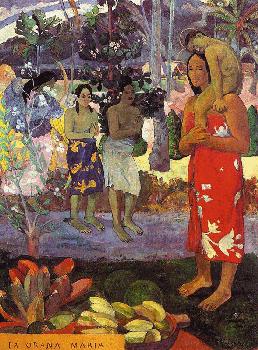
On the left is a Gauguin painting of Tahitian women wearing pareos, which are like sarongs. Today they are mostly used for beachwear. On the right is a photo showing how Tahitian men wear pareos. E427 Ia orana Maria; Je vous salue Marie 1891 (New York: Metropolitan Museum of Art)
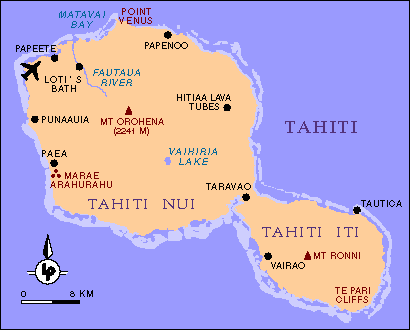
(Source: http://fpx.metmuseum.org/fif=collections/ep/ep51.112.2.X.fpx&obj=iip, For an animated site that shows how men and women put on the pareo, cliquez ici. Papeete is the capital of French Polynesia. You can see it on this map of Tahiti, where you can also see the Fataoua (or Fautaua) River, along which Rarahu lived with her adoptive parents.
(Source: http://www.southpacificdirect.com/TAHmap.html)
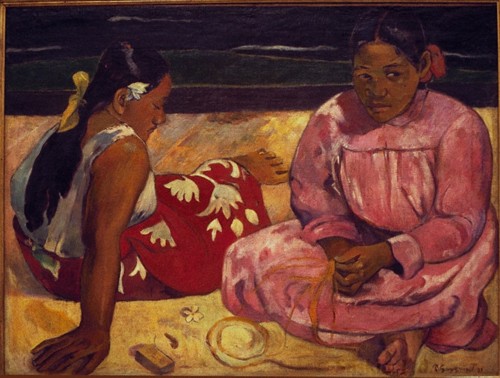
On the left is a Tahitian hibiscus. Tahitians, mostly women but sometimes men as well, still put them above one ear; which ear and how it is placed is a code for the marital status and intentions of the wearer. In the Gauguin painting on the right, one of the first he did after arriving in Tahiti, you see two Tahitian women with flowers behind their ears. The one on the right is red, and was probably meant to be a hibiscus. The white one on the left was probably meant to be a tiare, of which more in Reading 32. E425 Deux femmes sur la plage 1891 (Paris: Musée d'Orsay)
|


2 Elle restait peu de temps à Papeete après le service religieux, évitant la société des jeunes femmes, les échoppes des Chinois marchands de thé, de gâteau et de bière. Elle était très sage, et, en donnant la main à Tiahoui, elle rentrait à Apiré pour se déshabiller. [...]
Révision de la lecture
1. Qu'est-ce que Rarahu mettait pour aller au temple protestant
le dimanche?
2. Qu'est-ce qu'elle mettait au-dessus de l'oreille?
3. Qu'est-ce qui indique la sagesse de Rarahu?
Révision de la grammaire
7.1 "elle piquait au-dessus de l'oreille . . . une large fleur d'hibiscus, dont le rouge ardent donnait une pâleur transparente à sa joue cuivrée."
What does dont indicate here? (II.B.1.c.)
7.2 "Elle restait peu de temps à Papeete après le service religieux"
Notice that the preposition for in or to when speaking of cities (or small islands) is à.