RYAN L. CLAASSEN
Professor
Department of Political Science
Kent State University
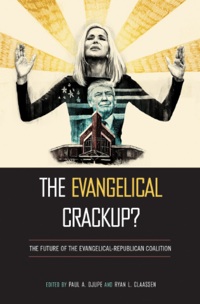
The Evangelical Crackup?
Description:
Why did Donald Trump attract a record number of white evangelical voters without unified support—and despite nontrivial antipathy from evangelical leaders? The editors and leading scholars that contribute to the timely volume The Evangelical Crackup? answer this question and provide a comprehensive assessment of the status of evangelicals and the Christian Right in the Republican coalition.
The expected “crackup” with the Republican Party never happened. Each chapter in this cogent volume includes analyses of the 2016 election to explain why—and why that is critical. Chapters examine policy priorities, legal advocacy, and evangelical loyalty to the Republican Party; rhetoric, social networks, and evangelical elite influence; and the political implications of movements within evangelicalism, such as young evangelicals, Hispanics, and the Emergent Church movement.
Contributors:
Daniel Bennett, Mark Brockway, Ryan P. Burge, Brian R. Calfano, Jeremy Castle, Kimberly Conger, Daniel A. Cox, Kevin den Dulk, Sarah Allen Gershon, Tobin Grant, Robert P. Jones, Geoffrey Layman, Andrew R. Lewis, Ronald J. McGauvran, Joshua Mitchell, Juhem Navarro-Rivera, Jacob R. Neiheisel, Elizabeth Oldmixon, Adrian D. Pantoja, David Searcy, Anand Edward Sokhey, J. Benjamin Taylor, Robert Wuthnow, and the editors
Praise:
“ Scholars of this and future generations will spend untold hours, even lifetimes, sifting through the ashes of the 2016 presidential election. This excellent book, The Evangelical Crackup? , provides an invaluable foundation for that scholarship.”
—Randall Balmer, John Phillips Professor in Religion and Director, Society of Fellows at Dartmouth College, and author of Evangelicalism in America
“ Evangelical support for Donald Trump in 2016 seemed inconsistent with many of our standard theories and explanations. In this essential volume, Djupe and Claassen have assembled essays by the leading scholars of evangelical politics to help us better understand the role of evangelicals in the 2016 election and beyond. Scholars and citizens interested in evangelicals, in American elections, or in contemporary politics will find these essays invaluable.”
—Clyde Wilcox, Professor of Government, Georgetown University, and author of God’s Warriors: The Christian Right in 20th Century America
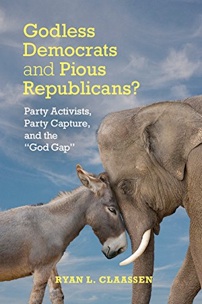
Godless Democrats and Pious Republicans
Description:
Do Evangelical activists control the Republican Party? Do secular activists control the Democratic Party? In Godless Democrats and Pious Republicans, Ryan Claassen carefully assesses the way campaign activists represent religious and non-religious groups in American political parties dating back to the 1960s. By providing a new theoretical framework for investigating the connections between macro social and political trends, the results challenge a conventional wisdom in which recently mobilized religious and Secular extremists captured the parties and created a God gap. The new approach reveals that very basic social and demographic trends matter far more than previously recognized and that mobilization matters far less. The God gap in voting is real, but it was not created by Christian Right mobilization efforts and a Secular backlash. Where others see culture wars and captured parties, Claassen finds many religious divisions in American politics are artifacts of basic social changes. This very basic insight leads to many profoundly different conclusions about the motivations of religious and non-religious activists and voters.
Praise:
"This thoughtful and empirically detailed study of religion and party activism takes us miles beyond simplistic commentaries about godly Republicans and godless Democrats."
—Morris P. Fiorina, Stanford University
"Ryan Claassen's Godless Democrats and Pious Republicans? makes a major contribution to increasing our understanding of how religious divisions impact American party politics specifically and American society more generally. Rejecting oversimplified notions of party capture and mobilization, Claassen provides a nuanced and comprehensive account of how religion and politics have interacted during the last half century. It will force scholars to reconsider conventional thinking on this important topic."
—Edward G. Carmines, Indiana University
"By exploring the social roots of secularization in the American electorate, Claassen provides fresh and original insights into the role and origins of religious divides in US party politics. This account deserves to be read by scholars of contemporary American elections and voting behavior, parties, and religion, while the broader lessons also shed light on the connections between religiosity and party politics elsewhere in the world."
—Pippa Norris, Harvard University and the University of Sydney
Reviews:
Ben Gaskins in Political Science Quarterly
Stephen T. Mockabee in Politics and Religion
Paul Helmke in Contemporary Sociology
Brad Lockerbie in Public Opinion Quarterly
James L. Guth in The Christian Century.
T. Marchant Shapiro in Choice Connect.
Related media: