Oh Yes, Your Art Degree is Worth Something!
March 23, 2026
So I just put the kibosh on the penultimate draft of my thesis. WAAHHHHH. That means I don’t have to deal with it anymore. Don’t? Yes, my friend, this bloated mass of Thing has become my life the past year-and-a-half and I’m sad to let it go for two weeks while my defense team squints at it.
I was going to write that they were going to ream it to be not only funny but rhyme-y, but I held myself back. Because the entire point of my rant today is to rally against such potentially self-deprecating language, see.
Now, before you ask yourself, “but Sophie, why’d you go any brand yourself an authoress, then?” Isn’t that a bit demeaning in today’s modern world?” I must tell you, friend, that there is a fine line between having a laugh and having a cry, as much as tears and giggles like to mingle. I call myself an authoress because it’s cute and it lets me take myself a little less seriously and I enjoy embracing my femininity. There is a big difference between doing something such as that, and attempting to socially invalidate your entire existence just because you’re, gosh, a woman who thinks!
Which brings me to the incident that triggered me firing this post off. In my failed attempts at staying a relevant participant in society, I do follow a handful of fellow young vintage fashion enthusiasts, as well as some older ones, on, harumph, Instagram. A website I don’t go on too much anymore because it’s mostly all just minging and people being superficial. (I’d much rather add your personal webpage to my RSS feed anyway.) Such as one girl who is currently getting her masters in museum archival and recently uploaded a paper she wrote for one of her classes to this very website. It was a nice little read; the tone was a bit stilted and the grammar was off in a few sentences, but with just a bit of editing it would be a perfect fit for any of the journals I’ve scrounged up on JSTOR or through my university’s state’s library system for research purposes.
Of course she promoted this lovely little triumph of academia by calling herself an “idiot” for spending too much on a useless degree. Mind you, this individual moved across an ocean to study her passion, a dream that many college students wish they could achieve for even a few weeks out of one semester, and something I myself had to sacrifice because I was too busy with on-campus activities. (Fingers still crossed for Royal Holloway, though. Am I allowed to say that or is that going to jinx it? Oh no.)
This individual also isn’t the only young woman I’ve seen scoff at herself for earning a “useless” degree, almost always in art or fashion history. (Very different connotation than adding a feminine suffix, isn’t it?) This trend deeply troubles me even more than the existence of trends in the first place. As someone with a closet full of old clothes occasionally sourced from literal attics at estate sales, fashion history in particular has opened me up to fascinating pockets of culture and subculture I would have never known of had the field been left to dust.
Such as the Portobello Road bohemians, who rejected the consumerism of the swinging sixties with their lust for antiques and renovated cars from the forties. Shirley Russell, possibly my favorite costume designer of all time, would buy ancient garments in prime condition for pennies — er, pence — at markets there to outfit such stars as Twiggy in films by her infamous hubby, Ken Russell. Or Emilie Flöge, muse of Gustav Klimt and a clothing designer and boutique owner in her own right, who made me realize that not only were the sixties’ young Carnaby Street pioneers her spiritual progeny, but that the seventies dresses in my closet looked exactly like they came from the Victorian dress reform.
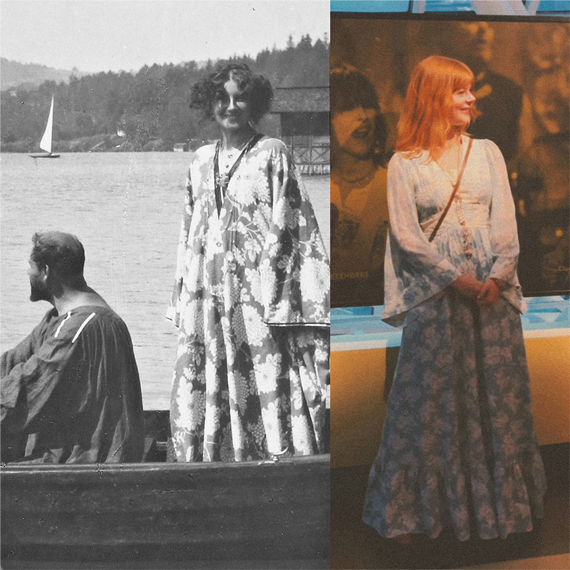
I couldn’t help but feel excitedly kindred, and I immediately elevated Flöge high-high-high on my nebulous mental list of women heroes/muses/‘queens’/angels. See? Knowing history, especially that which pertains to culture, is a manner of establishing ourselves as we exist now in a continuum of humanity.
Admittedly, this practice is often easier said than done. For one thing, history has long been the site of institutionalized impersonality, from statistics regarding ancient wars to Thomas Carlyle’s famous great-man theory. Thankfully, this regard has been in slow decline; how much is there left to be said about Gettysburg? In classes I took on medieval and Renaissance Europe, there was much discussion of ‘microhistories’, namely Gene Brucker’s Giovanni and Lusanna: Love and Marriage in Renaissance Florence, which, in perceiving history from the bottom-up, are essential to gathering the full context of any period of time, namely in regards to how much things, well, stay the same. That may not seem like the point of history, but as a learned historian on my way to a lovely little degree, I’ve realized how essential realizing that is to truly grasping the magnitude of centuries of human activity behind us. If Patti Smith can call Mary Magdalene was “the first groupie”, so be it; history is really all about the little details and quirks. As a cultural conversation piece, however, the field still largely revolves around what will get in the history book and the ‘magnitude’ of this, that, or the other.
Too, acknowledging the little histories is to recognize one’s research subjects as human, which is to acknowledge that they are no perfect robots. Realizing that your forebears went through the exact same groggy mornings, anxiety-fueled head-spins, and moments of complete and utter experiential neutrality as you do is can be an emotionally laborious process, especially when common themes in your line of research are mental health and substance abuse struggles, media scandals, and, in many cases, early death. As is the case for my research into rock and roll — having the differences between the shiny-tabloid depictions of these people in sleaze-rags such as Rock Scene and their actual lived experiences dawn on you can be truly mindboggling.
While rock writing is a field that traditionally rejects neutrality — hi, Lester! — historical perspective and emotion are generally perceived as mutually exclusive. Joli Jensen, in Lisa A. Lewis’s 1992 anthology The Adoring Audience: Fan Culture and Popular Media — one of the most interesting I’ve stumbled across while writing my thesis — sums up the situation with incredible vulnerability and accuracy. In Jensen’s observations, it is passion that separates the “scholar, collector, aficionado” from the mere and socially mockable “fan”, who “[risks] obsession, with dangerous consequences” through his or her engagement with culture. It is that passion that renders not only the passionate but the subject of that passion “unworthy” of serious cultural consideration.
You especially ought not be a woman and show any inkling of yourself as a being capable of experiencing anything remotely resembling emotion towards your subject, which is the easiest way to put the kibosh on your credibility. As a music historian, I know this all too well, having been bombarded from my earliest days of engagement with the field with stories of elder stateswomen fearing the dreaded label of ‘groupie’. (Never mind that Lillian Roxon, Germaine Greer (yes, that Germaine Greer), Margaret Moser, and, of course, Pamela Des Barres all wielded the identity the same way Jensen says she does her aficionado-dom — “with a vengeance” — and turned out just fine.)
Why is it, then, that academic pursuit has become so stigmatized not just among women, who have proven themselves to be capable in the field since the days of Christine de Pisan? If the forces of history are to be believed, it certainly has to do with much more than who’s in power or the silly economy. In my personal, microhistorical experience, the concept of revolving one’s life around something one loves — be it research or putting rocks through a tumbler — is often considered by society, for lack of better terminology, ‘monetizing a hobby’, equated with small businesses folding after a year due to lackluster sales or the dreaded ‘burning-out’, leaving one with a resume they can’t bear to look at and an irreversibly changed relationship with something that once fueled them to get out of bed each morning. Too, qualities such as passion and devotion are just too corny for modern life. Shacking up with a man and staying with him for the rest of your respective lives? Talk about the Hallmark channel! And if you do get a divorce someday, you’ll really look dorky. Dreams of white weddings and baby carriages — traditionally very feminine dreams, mind you — are for nerds in a world more concerned with blaming every social ill on either the Male Race, the Male Race As It Exists In Power, or, well, the silly economy.
How one looks, however, is of top priority; if you are a regular user of this very website and are, like me, a young brainy woman, you have undoubtedly encountered at least one musing romanticizing the image associated with writers, regardless of whether the musing itself said anything larger than itself. Just as music writing is propagated with wannabe shock-jocks who embrace the allure of the tabloid, the writing world at large appears to be currently dominated by people who turn one’s involvement in anything resembling academia into an aesthetic of reclusive dedication that differentiates one’s self from the supposed herd — if you will, the Silent Majority.
The problem is is that whether the copy of The White Album you’re carrying is a record or a book, there are many others out there just like you who have found profound meaning in creation and the sacrifice it takes. Problems occur when that passion is flattened into something which can be digested easily and without any sacrifice whatsoever. It means I get to see some girl — I call them girls and then half of the time they’re older than me — twirl her hair and call herself crazy and call the books on her shelf a neon sign pointing towards some barely-defined deep-seated self-trouble, and I want to grab her shoulders and shake her and tell her no, you’re not crazy, and your academic inquiry is not some sort of neurosis, and there’s damn well not going to be a day when no one will listen to you anymore because you’ll be ‘no longer beautiful’, and don’t you know that beauty comes from within?
Given historians’ often rocky relationships with women nowadays, it is no wonder that such concerns would be at the forefront of the field’s most nascent crop of ladies. I haven’t read Laurence Leamer’s recent Warhol’s Muses: The Artists, Misfits, and Superstars Destroyed by the Factory Fame Machine, but its title truly says it all as to how it portrays its sexes: men as oppressors, women as throwaway victims of said oppression whose contributions to history are only capable of being percieved through such a reductive dichotomy. I have, however, read Susannah Cahalan’s The Acid Queen: The Psychedelic Life and Counterculture Rebellion of Rosemary Woodruff Leary, a fascinating tale of the woman who was Timothy Leary’s wife during his cultural ascension in the sixties. Aside from some lousily-cited potshots at the turn-on-tune-in-drop-outter and descriptions of female medical trouble which I found unnecessarily graphic in detail — something I have noticed in multiple recent biographies of women, unfortunately — I was most uneasy by the author’s insistance that Woodruff apparently let herself go in her later, post-Leary years, despite the photo of her from her final photo shoot included in the book’s gallery section proving that she was still absolutely gorgeous.
It truly wows me, this wider cultural obsession that’s going around right now telling me I ought to experience utter shock and disbelief should a woman be over fifty and still stylish, cool, herself despite all that the world has slung at her, and, well, beautiful. As someone often surrounded by women over fifty who are such things — my mother, other mentors — I suppose I’m primed to not find such stories so unbelievable. Too, most of the people parroting such narratives are themselves older women who most likely have their own insecurities regarding age and appearance, which are perfectly alright and natural to have; it is endlessly disappointing, however, when they trickle into historical narratives as if people haven’t been growing old since, well, the dawn of time.
At its heart, history is a uphill and often futile battle against bias. (For a decidedly rock-and-roll perspective on historiography, I highly recommend this lecture by one of my reigning life-heroes, Erin Torkelson Weber, as well as her show-stopping book, The Beatles and the Historians.) However, I do not think this struggle cannot coexist with a wider consideration of the existence of emotion and the roles emotion plays in the moments that define history. Women, traditionally perceived as the more emotional sex, are hypothetically at a great advantage in this regard; hypothetically, they are more in-tune with what it means to feel those emotions, as it is more socially acceptable for them to do so than a man. Women have the ability to extend the observations of Edie: An American Biography authors Jean Stein and George Plimpton — that “those for whom being interviewed must have been a novelty, the women particularly” can provide “the freshest, most informative material”** — to the very act of conducting said interviews, embarking on deep-dives, et al.
However, it is up to any historian, however, to validate their contributions to their field — to make that great argument that this history is worth researching and recording, even if the average person would never think so. Maybe one day historians will study the internalized self-loathing that has become part and parcel among not just women historians but women’s history in general, if supposedly-definitive biographies are continuing to instate harmful archetypes under the guise of dismantling them, seemingly without any self-awareness whatsoever. History is a beautiful thing to love; but, alas, everything that is beautiful has its imperfections, and no matter how awe-inspiring something may be regardless, it is always best to at least try to take those extra steps towards self-improvement and happy mediums.
** From the introduction to their first book, American Journey: The Times of Robert Kennedy, in which they first delineated their oral history strategy, later elaborated upon by Legs McNeil and Gillian McCain.
Trick of the Light
December 17, 2025
So we’re working on a Who puzzle.

There are no eye pieces. None that look anything like a mouth. There are not even clear signifiers of Roger’s hair. It is nothing but a sea of grey, in varying shades and textures.
In short, we are in hell.
We have, however, constructed what appears to be Pete Townshend’s ever-tortured forehead, and have begun work on what we’ve realized is Keith Moon’s hairline. The rest is connecting fragments of clothing creases, forming mental models of individual smooth-nesses, and putting up with the awful glare our dining room lamp projects.
I was gifted this puzzle for the holidays by one of my greatest mentors who knows well of my puzzle-lust. But not even my partner-in-crime, my mother, is having fun doing this, and all I can do is pretend that stockpiling vast voids of grey is in any manner satisfying.
I’d cry out for help, but I’m really not interested in inadvertently causing a puzzle-related breaking and entering at this time.
Caligu-Li, Caligu-La
December 12, 2025
In 1979, Avon — the cosmetics company responsible for trinketized perfumes, shampoos, bath oils, soaps, and more sold door to door — offered as one of their uber-collectible items a small series of blue Greco-Roman vases, adorned with cutesy portraits of women in togas. One of them, now culturally reduced to a flea market delight, sits atop my bookshelf, with the original packaging on my bedside table; apparently, it once housed ‘Somewhere Cologne’. Now, it just sits there, some old sewing patterns leaning against it, cherub-like children playing under a tree across its rounded surface.
Whether the wholesome folks at Avon had Caligula in mind when they designed the pieces is unclear, though the film had been building hoopla over the course of almost four years upon its initial release in that very year. They were probably just adding a new flavor of nostalgia to their lineup of glamorous bottles, Aladdin’s lamps, old-timey cars, and owls. The American broadcast of the wildly successful television series of Robert Graves’ I, Claudius was not too distant in cultural memory, so perchance that work’s ode to the political scheme and colorful characters of ancient Rome was a subconscious influence. Maybe they were really excited for Xanadu.
Unlike Xanadu, Caligula does not have an extremely catchy theme song sung by Olivia Newton-John;** it does, however, have Malcolm McDowell doing a strangely serious victory-dance numerous times, as well as, in its newest iteration, a droning and ominous synthesized hum that soundtracks its uncanny images of lonely grandeur. Rome, to Gore Vidal — er, Tinto Brass — er, Bob Guccione, is a soundstage, an alien planet.
This atmosphere is multi-dimensional. The film itself holds an uncanny spot in cultural history, is perceived by those who recall it as having been made by minds on some higher level, the last surviving participants in some lost civilization. It boasts one of the most infamous behind-the-scenes stories of any film out there; it’s the sort of film whose scriptwriter — Vidal — and director — Brass — did not want their names attached to whatsoever. Completely unrelated pornographic scenes were inserted throughout by Guccione, the film’s producer and founder of Penthouse Magazine. And so on.
Those scenes are not present in this new version of Caligula. Helmed by art historian Thomas Negovan, it is dubbed the Ultimate Cut, which is a name I find totally corny and useless, though it is inherently noble in its attempt at restoring Vidal’s original script as closely as possible. This, of course, is impossible, since that script focused heavily on homosexual scenes that were written out by the time filming began; however, that is not to say that one can’t try.
I have always been curious about creative works that have been banned or censored, so I knew of Caligula’s history roughly, or more so its reputation as lurid and, in many assessments, poorly. But the historical significance of its existence is quite different than some comparable works owing to its medium. Films are costly to make, and Guccione genuinely sought to pioneer both the presence and normalization of hardcore materials in mainstream film. And while you can still easily find a copy of Blind Faith at your local record store or Fanny Hill at Salvation Army, film distribution is much trickier and many true classics can only be viewed nowadays by purchasing a copy that has been out of print for decades, or happening upon a screening in a town cultured enough to have a hip theatre with an ongoing hip classic-film series.
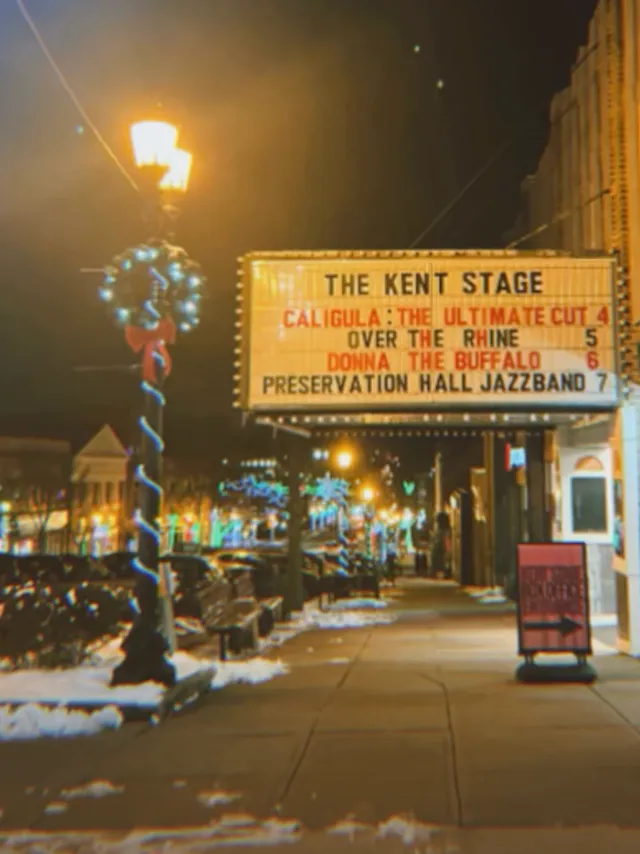
Despite its rich cultural history, Kent, Ohio is normally not one of those towns, unless it’s the monthly Rocky Horror screening at the Kent Stage (the line goes down the entire Main Street block on Halloween). And while the Nightlight and the Highland Square Theatre in Akron both play a plethora of films, popular and obscure, old and new, not all college kids have the car needed to get there. You have to suffice for the MovieScoop a quick Downtowner bus ride south of town, where I recently saw Frankenstein, which was just slightly offensive to me as someone who had actually read the book. So when I learned that this new cut of Caligula was being screened at the Stage, a ten-minute Campus Loop sit away, I flipped. This was the utopia that Richard Myers of Akran and Deathstyles fame was building when he screened Fellini Satyricon for film classes attended by Mark Mothersbaugh, resurrected from long-buried rubble. (Of course, I was one of about a handful of people there, which is disappointing, though the male-half of the couple behind me did stop making comments to the lady-half after I shushed him.)
We open with a short animated dream-prologue, and then abruptly we are sucked into the wonderful world of Caligula; we learn very quickly that the woman cuddled up with the emperor is his sister, and it only gets more colorful from there. Quickly I settled into the reality this film constructs across its many luscious sets — every scene feels utterly self-contained, a moment in time captured in a jar, in a subconscious freeze-frame, yet each feels so alive. Some have complained about the film staying past its welcome — there were quite a few false-climaxes for me — but to me every second felt perfect and earned. I had to keep reminding myself as I watched that this was not a film crafted decades ago — no, this was reconstructed by hand in very recent years, reanimated with care and love. Watching this film for the first time with this presentation was a truly phantasmagoric experience, like stepping into an Orphean mirror world where everything moves simultaneously in slow motion and at exactly the right pace to digest it. Once I had adjusted to it, I felt fully immersed.
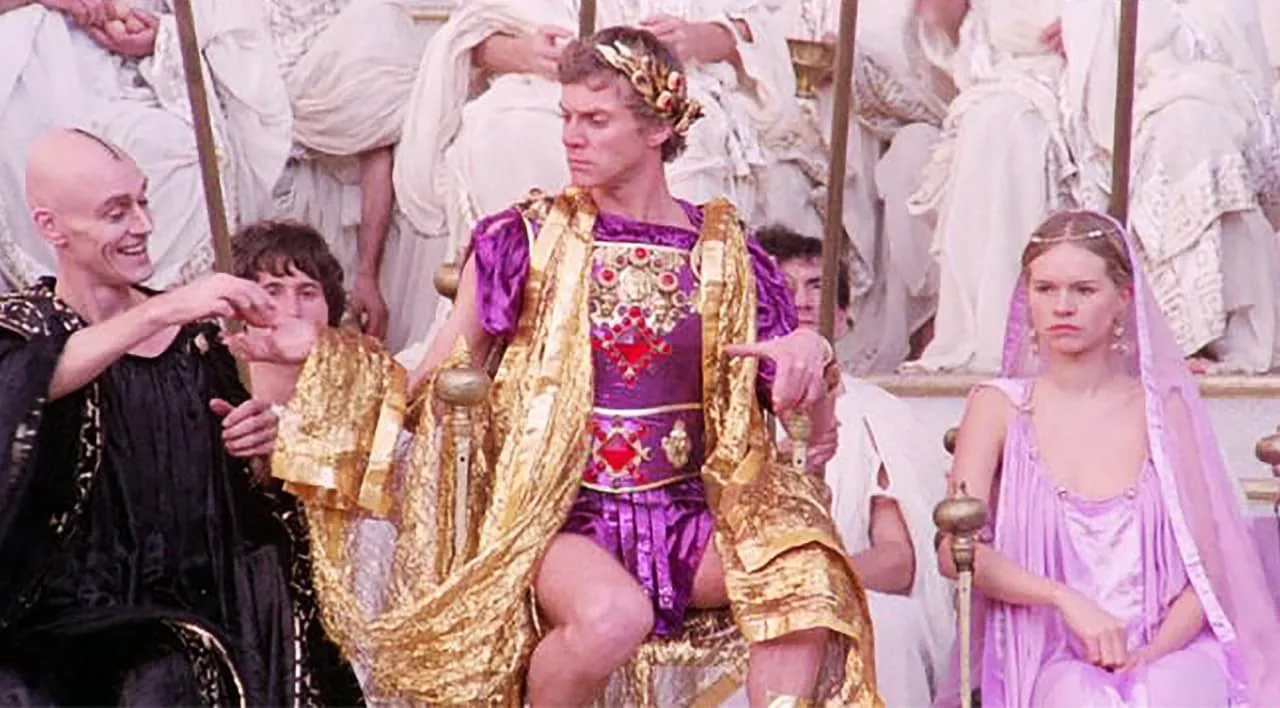
Perhaps no other film exhibits a greater appreciation for the human form. “This film’s costumes were obviously designed by a man,” I thought as I examined the ridiculous coils of silver wrapped seductively around the muscular arms of extras. Danilo Donati, the costumist who also outfitted numerous Fellini films including Satyricon and Casanova, Zeffirelli’s Romeo & Juliet, and Salò or the 120 Days of Sodom, deserves to be a household name nowadays, especially given the brief renaissance of the middle film’s style that spread across the internet the other year. The strokes of gauzey color, the flow of fabrics, glitter and sequins and peacock feathers — the colors, oh the colors. Robin’s egg blue is the most prominent and consistent one, but the whole rainbow, in bright pastels, is on display across over three-thousand-five-hundred costumes, of which only one survived. Blinding white sometimes whets the eyes, but there is always a painting box of finery on hand to defile it.
There is a comic-book like quality to Caligula, with its surreality and the strange perfection of every shot, yet there is a strange humanity underlying that unearthliness. It is an undercurrent that guides the film through its many vignettes, and McDowell’s performance in the title role, as intense and terrifying as it is self-possessed and alluring, is the harborer of this quality. His evolution from somewhat virtuous to monstrous is so subtle as to be barely present. The youthful vigor and striving spirit he exhibits in early scenes is perfectly foiled — and utterly quenched — by Peter O’Toole’s Tiberius; the aged emperor is clearly stoned and physically decrepit, visibly riddled with venereal disease yet still wrapping himself in gold-trim robes and surrounding himself with undressed women. There is much to be said about fate in this film, and if its portrayal of Tiberius says anything, it is that Caligula is doomed from the start. The not-so-prodigal grandson’s nightmares are much more than his own subconscious working against him; they are a reflection of his reality.
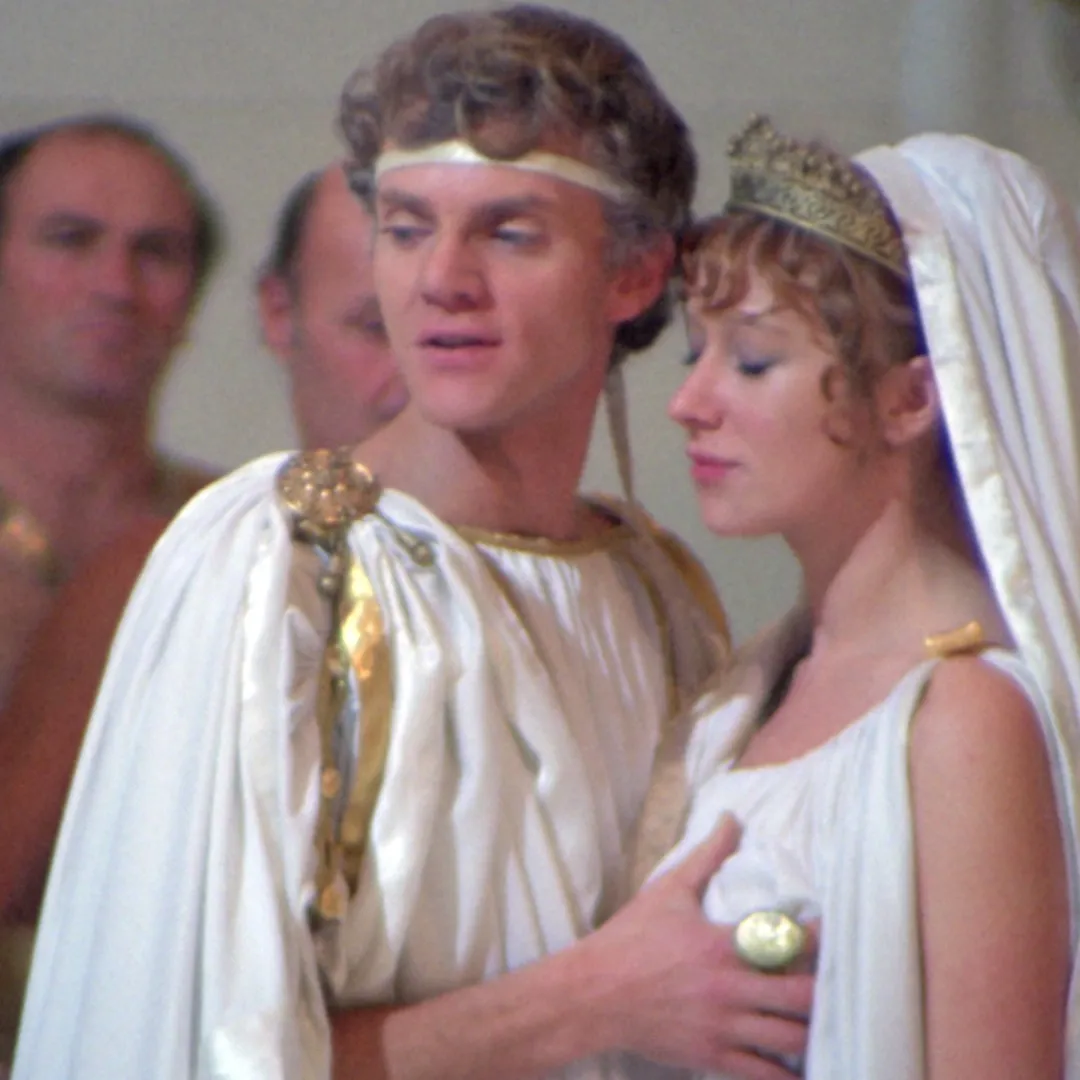
Any true innocence that Caligula harbors is very quickly plowed by blood-lust, yet he is still fully capable of entering boyish sprints in moments of inspiration, embarking on a game of Simon-says at a banquet, eliciting sheep noises from his Senate, or casually fondling the breast of whichever woman he is closest to. Helen Mirren’s Caesonia, who becomes his wife a ways into the film despite being ‘the most promiscuous woman in Rome’, is often the target of such cupping, not that she seems to care beyond poised amusement. And if any man of any stature or hubris found himself with the actress partially nude strode across his lap, it would be only natural for him to utter to himself, “I’m a god!” as McDowell does here. This Caesonia is utterly graceful in her sexy stoicity, in no way a true challenge to Caligula’s power but a strong and distinct character nonetheless, clearly intelligent and aware of the position she holds in society. Teresa Ann Savoy’s Drusilla also has a degree of awareness — “but we’re in Rome!” — but not nearly as much personality; this makes sense given Caligula’s perception of his sister as a vessel through which he can feel carnally proud of himself and his bloodline.
This sort of intensity of the film’s commentary — on social, political, and emotional systems — is offset by its embrace of the delirium of heightened people in heightened situations. I was delighted to see how many positive comparisons the film has gotten to those of Ken Russell, the master of balancing beauty with the grotesque. (Mirren actually appeared a few years earlier in his excellent biographical film Savage Messiah, playing a suffragette who gets super naked, which I realized as I wrote this is a great way to introduce Russell in general.) I’d argue this film owes as much to, say, Satyricon as it does to him, especially his then-recent take on the eighteenth-century, Lisztomania — which got a nice spread in Penthouse’s rival, Playboy — with its opulence and vibrancy that shimmers like a field of sequins with every scene-dressing candle-salad object. The man was also wildly funny, as are Caligula’s subtle and perfectly times doses of humor: the silly marching-around, the emperor’s ludicrously premature announcement of the birth of his son, et al.
Legend will tell you there is an actual crowning of a baby in this film, during the scene in which Julia Drusilla is born; three separate pregnant actresses is the common statistic. While I was taken aback by the presentation of this event, the event itself did not faze me; I remember thinking how impressive the special effects were — even the baby’s head looked absolutely real! That doesn’t mean I wasn’t shocked, however; this was just one of the scenes that proves that Caligula not only pushed boundaries then but remains potent in inspiring the wildest imaginations of an audience that persists to this day. It is engrossed in the inherently unwieldy journey of discovering what an audience can and cannot take. The gall of the wedding scene in particular — I suppose if you know, you know — left me stunned beyond real emotion, forcing me to look back on it through the inherent humor of something so universally vile followed by something equally so yet even more ridiculous.
Other scenes have people engaging in degenerate acts for the sake of it in the background or full-blown orgies, often daring one to smile and squirm at once. Yet scenes like the assassination of Tiberius are filmed in a skillful manner that avoids to maximum effect; what other film finds strange beauty in asphyxiation, acts out these terse political power dynamics with such grace? The entire film is choreographed like a twisted ballet; perfect blocking accentuates the fluid, lively motion of bodies and muscles and the weapons they wield.
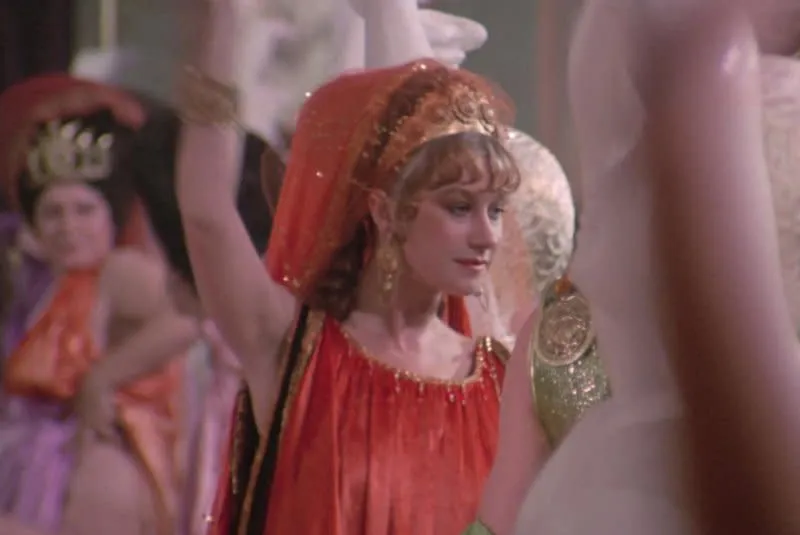
You can make some lazy blah-blah-blah statement about how ‘relevant’ its themes are or some other blah-blah, or sex in today’s age and blah-blah, but doing so would take away from the timeless effectivity of this film. It is as much about politics as it is about power and its exotic, panther-like glamour, a glamour that pounces out from complete darkness like a vengeful god. It is a three-hour historical epic of Biblical proportions and Myra Breckenridge implications, to allude to Vidal in tribute to both his book of that title and its own controversial film, which the author despised. I, however, love that film, and I love it in a similar way as to why I love Caligula: both are utterly revolutionary. What Myra did to the raunchy sex comedy in its bombast, Caligula did to the pompous, gilded epic, elevating to the level of scripture the myths that the cultural osmosis of history often reinforces. Much of the infamous emperor’s true ‘insanity’ has been put into question by source analysis; much of the history of his life was written generations following his death by those who sought to discredit his rule, a fate faced by all of his rank. Caligula’s inaugurating his horse to the position of consul, for example, never happened, and the concept of doing so was either entirely invented by these detached opponents or nothing more than an extended in-joke targeting the Roman Senate.
Of course, Incitatus is given the good-boy treatment he rightfully deserves in this film. And incest is a central plot point, though those allegations were actually ledgered at his interactions with his (three separate) sisters and not only Drusilla, though she was often singled out as his favorite. And why wouldn’t these strange, baffling, lurid things occur in the operatic life of Caligula, this mononymous childhood nickname of a man? When the facts will all be conflated with exaggeration and the secondary players’ names will be lost to time, why wouldn’t you go all out? If culture has rendered those of your rank disposable by suicide or political assassination, why wouldn’t you treat those around you as such? Why wouldn’t you spend the average-four years you’d receive as ruler of the world’s most powerful empire living not just as an emperor, but as something above human? Despite the many men and women who put manpower into this film, Caligula still comes across as highly individualistic; it extolls the great-man theory of history as much as it burns it, makes awe-inspiring firecrackers from the burning embers. It presents a world in which anyone can truly do anything, and it just so happens that that entire ethos exists within one man. Every generation, of any time, deserves this sort of combination, where those in the highest positions of power meet the lowest positions one can place one’s self.
The film does slow down a bit near its end — the side effect of placing big scene after big scene after big scene, and every scene in Caligula is big and bright. I was ill-prepared; I somehow did not realize the film was going to be three hours long, leaving me yawning, fidgety, and craving the snack I had not bought at the concession stand, all against my will, for the last thirty minutes or so. But it was perhaps as a result of this fighting state that Caligula’s most shocking scene, to me at least, was its conclusion, where the emperor is assassinated. I felt that knee-jerk reaction that get when I feel tears coming; there was something so astonishingly stupefying at seeing the spear and the blood and the look on his face. The brief, barely noticeable glimpse of Julia Drusilla, who never lived to see past the age of one, getting her head slammed against the ground did not help, but neither did the concept of this immortal story ending, fading to black; I could not bear to think that this film was going to be over and felt almost renewed at that realization. I was shaking my head, I was truly awe-struck; I did not want to leave this strange new world where anything was possible. Even I could do anything I wanted in this world! This is what sensation feels like — not some lowbrow screed against an easy target but a true, actual feeling! And the credits rolled, as they must do, always, every time.
** If you would like more Electric Light Orchestra in your art-film-going, however — and why wouldn’t you —there is a cut of Kenneth Anger’s Inauguration of the Pleasuredome set to the Eldorado record. If you’re more into the eighties-eighties than the seventies-eighties, the folks behind the Ultimate Cut also made a kind of brill April Fool’s Day post promoting an updated version of the film featuring ditties such as “Relax” by Frankie Goes to Hollywood, direct to eight-track.
On Hitting Two-Hundred Fifty Pages
October 22, 2025
The memoir is going to be the death of me.
Or maybe I should not have shotgunned Roger Daltrey’s and Pete Townshend’s respective memoirs within the span of twenty-four hours the other week. I wasn’t reading-reading them, it was more so of a super-skim, but most of my reading nowadays has been super-skimming, because writing a research-based book, I’ve realized, is more akin to assembling a collage than one may assume. You clip out the passages that best fit your narrative, the bits that pop out at you, and assemble them like the paper effigies of pop-stars on a glam-rocker’s bedroom wall, scrawled letters to Marc Bolan from beyond the grave scattered on the floor. No wonder I’ve been loading up Pinterest so much lately.
Of course, the goal of my book is some degree of fairness. Roger Daltrey and Pete Townshend, whose respective existences are the crux of my book — which is to be about the persistence of their group’s 1969 rock opera, Tommy — are fundamentally different people, and I ought to be fair to that. Roger’s memoir is a more lightweight number than Pete’s; at one point in it he describes himself as “a deeply private person”. And I am, too, in many ways, so I can understand why his memoir is constructed the way it is: with carefully selected stories and a lot of heart.
Pete’s has a lot of heart too, though on the other hand, he has seemingly dumped every recalled detail of every emotion of every experience he has ever had into his book; but a man who has somehow outlived every bullet fired at his public character, including those which were self-digested in the form of substances both legal and illicit, wouldn’t be expected to feel as if he had much to lose. Taking on his over-five-hundred pages of spilled-everything after Roger’s milk-and-cookies was genuinely jarring, made me feel like some weird voyeur. I don’t like being privy so many details about anyone’s life. Everyone deserves privacy.
But I left both reading experiences with nothing but empathy. Both of these men have been through so much in their lives, which is obvious, but it is the emotional side of rock music, on full display in unique manifestations between the two books, that remains less touched than the surface level facts and figures. With the Who as a masculine force in a boyish field — that of rock music itself — it can even be more taboo.
This ability for emotion to be expressed is often the most obvious difference between the memoir and the biography. And the biography might as well be the death of me, too, if you can get away with writing one of John Entwistle that, in a well-intentioned portion running through some historical context as to the early-seventies, contains a throwaway mention of the May 6, 1970 shootings at Kent State. And I’m not going to name names or anything, but being a few months away from being an alum, I regret to inform you that we can read, and we can write.
Many of the most interesting facts you’ll come across while researching a book arrive without warning and when least expected, like that error. One of them for me was learning by complete chance of the existence of an unfinished biography that, if completed in its time, would’ve been one of the earliest biographies of a member of the Who. Aside, of course, from Dougal Butler’s portrait of Keith Moon, from 1981, which I just recently consulted; it contains the following quote, which tickled me pink:
No doubt there is, at this moment, some geezer doing a Ph.D. on the Psychology of Rock With Special Reference to Hotel Wrecking. No doubt he will provide answers to these perplexing questions and, at the same time, save the world for the rest of us.
Tee-hee. (I doubt Jenny Juniper Boyd’s degree has such a specialization, but remind me to get around to reading her book on the psychology of the creative process one of these days.)
It saddens me to learn of an incomplete book, to even think the concept. I’ve heard multiple stories about unfinished biographies in particular since — abandoned manuscripts and the probable lack of any officially sanctioned tome due to protective family, passionate research brushed off as an attempt at salvaging a humanities degree. Some of my greatest mentors in life have books upon books they’d love to write, but they’re too busy doing other things to do so.
And sometimes it’s baffling what does get published. A few weeks ago, I read a biography of a writer who I have found quite fascinating, and how grateful am I that I stumbled upon the publication for a dollar at a random thrift store, because the book left me with a profound discomfort that makes me genuinely feel a bit strange to still have it on my shelf. The author, hunting for clues of the writer’s enigmatic life, had this clear obsession-like fixation on her subject that rubbed me in a very wrong way. She was, to her own admission, a bit sheltered in her day to day life; her subject was more of a hedonist. There was a great psychological struggle there, one that made me worry for the author, because she wrote about it in a way that implied that such a struggle was even glamorous. She did this, I think, because she chose to glamorize the myth of her subject’s proposed life. Learning the reality beneath the veneer scared her. It was very strange, and I learned so many lessons from just that lazy Sunday I spent powering through it on how to incorporate one’s voice into a book that, in its research, carries an inherent level of responsibility and power. This is how this narrative is going to be shaped for generations of readers; I’ve downed what feels like dozens of Dell paperbacks, endless articles from everything from Creem to Rave to a 1970 feminist screed against rock music that was definitely written by someone who had never been to a rock concert to the tour book I bought when I saw the Who, which has a phenomenal blurb by Howie Edelson. I recently cited a clipping from Australia’s Rock Scene, which I have never heard of before and likely never will hear of again, from an eBay listing.
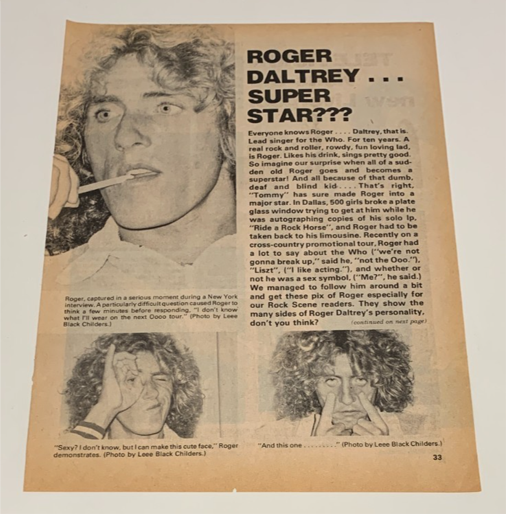
This thing. So if you’re writing a book, assembling this Gesamtkunstwerk, you ought to approach it with the intent of longevity, imagine it in some sort of pantheon, because you’re rescuing from destruction the scraps of culture that were once designated for the dustbin. You are preserving an incredible past that came before you, and you’d better have hopes in a future in an audience. The author of this book, at some points, even used cruel words to describe her subject, words I would never inflict upon another even within my own thoughts. I could just tell these words came out of jealousy, even if partially. Jealousy is one of the worst things you can rely on to fuel a work, second only to spite. It isn’t healthy to subject your audience to that; you have to balance the bravado you hold as an author with the self awareness you hold as a regular person.
I recently learned, as a result of reading not a memoir or biography but a more analytical book about music, about the ‘star text’. A star text is a narrative, usually composited through magazine articles, interviews, photos, and the like, that projects a mythological image of the ‘star’ around which it surrounds. Women-in-lives are hidden away to fuel the fantasies of admirers; archetypes such as the tortured artist and the glamorous socialite are constructed. There was a column in a glam-teenybopper rag purporting to be David Bowie’s day to day routine; it was really one of the magazine’s female writers penning about whatever she was thinking about or interested in, then foisting it upon the lad-insane.
David Bowie’s name in and of itself could count as part of a ‘star text’; it is sharp, like a knife, and unable to be easily mixed up with a Monkee. Would-be Sir David Robert Jones; should-be Sir Peter Dennis Blandford Townshend; Sir Roger Harry Daltrey. A lot has changed since I started writing this book and now, including that last title. I even saw the Who (which I promise you’ll hear about someday).
The largest thing that has changed, however, has been my confidence. Learning of the roadblocks that others have faced — things much worse than anything I could’ve ever even came up for for myself, to refer back to that unpublished biography — has proven to me not only the fortitude that a writer needs, but the fortitude I already have. Foraging your voice as a writer is something that requires humility; you have to bow to what truly moves you, and turn away when you find yourself writing a draft that just does not feel right. Not in a crappy-rough-draft way, but in a way that you find yourself just going on and on about symbolism and social hierarchy and blablabla and it just doesn’t feel correct to be going on that deep-dive, that nonsense tangent. So you keep it in the cutting-room-floor document, and maybe it will find its puzzle-piece spot at some point, but for now it will sit. And it will fester a little bit.
It’s a true honor to be a writer, to get to know really great people because of your work, to get to know people you’ve been acquainted with for years better because of your work, to receive incredible advice and have the guts to ask for it. To have the guts to critique a source or narrative that you disapprove of. It is hilarious seeing writers at papers I have written mock-cover letters for claim that their profession is not respected anymore. “‘Not respected anymore’. When have they ever been respected?” That is the response of one of my writer friends, who has been a guiding light for me this entire process. The only thing holding him back from the sequel is completing a degree; he’s not ready for the pimping process of lectures and book signings just yet, at this point in time.
Jason is quite the interesting cat, and anyone who can get Joe Walsh to write the forward to your book is worth talking to. He is one of the people I turn to most often in this writing process, because he is so optimistic. Knowing him has pushed my writing to such heights, and those heights are still slowly revealing themselves to me, and what an incredible process it is.
And then there is Chic. Oh, Chic. My mentor, my ‘college mom’, so many things in my life. I feel as if our bond as only deepened the wider my far-off horizons have gotten. And being introduced to Carol Gilligan’s In a Different Voice was, without hyperbole, a complete and utter game changer for the structure, span, and depth of this book. The ethos is still there — one of humanity, respect, dignity, and empathy — but it has become one million times stronger, infinitely better honed. It’s funny: women’s perspectives on, well, anything are always going to be exposing this human side of things. Look back at that clipping up there: compare the giddy text — the myth — to the silly faces — the man. That is what I hope this book will do, know it will: take a step back from the blinding light of the rock-star, peel it away like you would a band-aid, with care. As a daughter myself, it is of utmost importance to my writing process to consider that everyone, even heroes and stars, are also progeny; we were all once dribbling little babies in need of coddling, reality checks, and kindness. But women always have to be adapting to a man’s world of everything drooping downwards, never to see a brighter day, of the nonexistence of respect. We’re forced to talk in tired absolutes, in “never”s, deny the potential of any sort of change, progress. We deny the glory of breath, the beauty of the mundane, happiness streaming in through windows, the crunch of a cucumber or stick of celery at noon. So there will be a lot of that in the book, too. It was never going to be just a simple collection of facts.
Damage Control for a Walking Corpse
October 6, 2025
This time you’ll listen
To the movement of your body
How it keeps on to spite you
And it frightens you...
You’re desperate in finding
Something else to please you
You’ve been searching your whole life
Something to mute
Change, or just distract you
Something to put inside you
To give the illusion of life
‘cause you’re barely alive.
According to my mother and father, the first ever visible connection I made with music was because of Jenny Lewis. Our television picked up this weird little cable station which had a music video program, the name of which I cannot remember for the life of me now. “Portions for Foxes” came on; the song, recorded by Lewis’s group, Rilo Kiley, would have been a few years old at that point, and eleven-or-so-years-old me was apparently so enraptured that, after retreating to my bedroom for the night, I was listening to the song on repeat on my hand-me-down PC that the wood-paneled foyer had once revolved around. Looking back, there is a part of me that can vaguely remember experiencing that music video for the first time. I remember late nights gathered around the television watching the channel, watching it on my own on late afternoons. I remember seeing the tail end of “Bad Romance” for the first time on it and being blown away. And I remember flashes of details from “Portions for Foxes”, likely enhanced by the many times I would view the video on my own accord in the years to follow: the downy feathers falling, the plastic wrap encasing the four members of Rilo Kiley, the deep shadows cast across Jenny Lewis’s pretty face.
Like magic, the group’s four albums would make sail onto many crummy Sansa SanDisk portable players in the years to follow, downloaded through less than legal means by my father, who fell into Jenny Lewis’s redheaded snare alongside me. With repetition I would learn all the words to the album “Portions For Foxes” sprung from — More Adventurous —and its followup, Under the Blacklight, as well pretty much all of Take Offs and Landings, their first, though The Execution of All Things, the sophomore, evaded me aside from the title track. Why did I overlook the formidable rest? I really don’t know. All I know is that “Portions For Foxes” was a crown jewel of a discography of glimmering, perfect rubies. It was emotional, poised, so complex in its often paradoxical licks on loneliness, pain, love. I know I’m alone if I’m with or without you, but just being around you offers me another form of relief. I used to imagine, vividly, for some reason, the last three words of this sentence collapsing into a girlish giggle — fffform of relief — as Jenny collapsed in a laugh in a crowd-echo bar, surrounded by jovial girl friends. I suppose I interpreted the voicing of such quiet and small observations of emotion as an inherently communal effort. However humble her presentation through her sweet and utterly feminine voice, there was no way that Lewis could ever whisper those words. It was as if such thoughtful poetry was the one manner through which she could present these findings of the human condition to the world. There could never be just one person privy to her, regardless of how captivated I was, sitting in a chair with a tinny pair of foam headphones on.
That lyric is one of the many contradictions throughout “Portions for Foxes” — I keep on talking trash but I never say anything — and they all went together like one of those little wooden three-dimensional puzzles that looks like a little apple when you put it all together, stem and all. If all the odd-shaped pieces weren’t there, it would look off. All of these little details, each their own little world, combining into these massive statements, which themselves were their own little worlds, worlds of contained emotions wrapped in close-kept boxes, like the ones from Tiffany’s. You opened a box, and there on a tiny satin pillow sat an adorable open secret, the sonic equivalent of a caramel-drizzled gourmet chocolate.
It was so scandalous to me, at this age, that a song would contain the word “sex”. I would even censor it for myself, stepping in cautious circles at the top of the second story stairwell as if atop a rotating platform, an invisible guitar in my hands, imagining a sea of darkened heads before me and every ticket sold going towards helping children with cancer: And the talking leads to touching, and the touching leads to friends, and then there is no mystery left. I would fantasize, back then, about being a pop star, wrote fragments of songs on sticky notes in orange marker wore sequined scarves and t-shirts with innocent slogans emblazoned in glitter that rubbed off on everything. This was only natural for someone who grew up watching Hannah Montana and listening to Selena Gomez and the Scene. The Disney Channel taught me that pop stars were real people who cared about others, and so Jenny Lewis in subconscious ways became the big sister I never had, even though, to this day, calling her anything than her full name sounds just a little bit wrong. Some figures become mononymous in their fame, but Jenny Lewis always needed a first and a last. She had been born once.
This reality kept me from ever registering Jenny Lewis as truly titanic; she was more so this inevitable voice of reason, a woman who happened to be armed with this incredible ability to turn the introverted inside-out, bleed beautiful songs from strange wounds. There’s blood on my mouth because I’ve been biting my tongue all week. I could picture this vividly as I listened to “Portions for Foxes”, still can see the blood drip down her perfect lip, but I did not even feel bad for her despite the present tense. A part of me knew that, however passionate the emotion and however much human folly Jenny had faced outside the boundaries of the gritty clubs and venues the group once called home, this situation she was singing about was not a real one, but an imagined one — classifiable as tragedy, almost a comedy, definitively a play. In the realm of the Globe or any theatre, no matter how many bodies are left on that wood-plank stage, the actors will rise and do their bows to rapturous applause, and they will exit to the wings, and they will begin the next step of the cycle and prepare themselves for the next performance. And in the video for “Portions for Foxes”, the velvet curtains rise, and the feathers fall.
With the recent reunion tour of Rilo Kiley — which I unfortunately have been unable to see — Jenny Lewis has been back in the media spotlight. In the footage and photos from this current round of shows she’s as perfect as ever, wearing little vintage minidresses presumably from the seventies with their funky little art-deco throwback skirt-suit style. The pattern Butterick 3298, which sits in a cardboard box somewhere in the depths of my currently-psychedelic sewing room, springs to mind; it’s a little wrap dress with a pale collar and options for short, semi-puffy or long, puckered-shoulder sleeves, both with the dearest little cuffs.
I myself own a similar ensemble. It’s probably homemade itself, in watermelon pink gingham polyester. I got it for a steal at one of my favorite stops for vintage — Vicious Circle in Columbia, Pennsylvania — because it is so petite in size that it wound up in the children’s section. While I personally have never encountered a vintage boutique uncharging for larger sizes, which is something I hear many enthusiasts complain about but never provide evidence of, I can’t help but feel lucky for the inability of me to find clothes that fit me without having to deal with mothball scent and tired metal zippers. Except I am not so lucky, because when I don this ensemble and look in the mirror I look exactly like Jenny Lewis. Right down to the red hair against my back. I did not intend to ever have this occur to me at all, and it is so creepy to me that I barely even bear to pair the jacket with pants for a business-casual look. I rarely wear miniskirts these days anyway, especially not those that flare out. It’s not that I have bad legs — or bad legs compared to Jenny Lewis, whose gams are quite important — but I just feel out of place with my legs so out-there much of the time. I suppose, in this minuscule way, I’m growing up.
As Rilo Kiley have been around since the late nineteen-nineties and Jenny Lewis is now forty-nine, many of her listeners already have. And they are going to these shows and getting a bit happy-sad to be in a room of fellow disaffected Gen-X-ers who were disaffected teenagers when this music first touched them. I hear her work called ‘sad girl music’ and associated with suicidal thoughts that last well into womanhood (it is always womanhood, since manhood apparently doesn’t look at the lyrics, only looks at the idea of it, as well as the gams; womanhood is apparently blind to the gams, until now). It feels like an incredibly reductive label, even though “Does He Love You?” may just be the saddest song ever sung; it is true that no one writes from the perspective of the ‘other woman’ like Jenny Diane Lewis, and the epigraph in the CD booklet only makes the melancholia sting even more: Dear friend. Two words, and I am already crushed. Dear, then friend, followed by a comma. Dear friend. So sad! The whole thing is so sad.
But Jenny Lewis could never make me sad-sad, because in many ways her music was one of the great comforts I had as a young person. Jenny Lewis’s magic came and still comes from the fact that her music, in a unique way sounds like a friend. There is life lived both within and outside of each of these songs; they follow you down windswept streets as the pavement gets inexplicably wet and the days grow more and more overcast and the leaves turn the color of her hair. It is what makes “Does He Love You?” so crushing — Jenny’s mistress is fragile yet earnest. I am flawed if I’m not free.
Perchance these women I see talking about the tears they shed to Jenny’s word were older when they came across Jenny Lewis’s music, already disillusioned or at least seeking some sort of outlet for confused, artsy angst. And, like any proper rock star, Jenny Lewis served as a vessel for those often conflicting and barely explainable emotions, and the palpable breaths taken between each line gave some explanation, gave room for these women to find little corners they could curl up in and feel at home. Rilo Kiley and she in general became some thing you could consciously turn to if you needed it. But with time, I have learned that I can be blind to that which is not directly in front of me. I still cut into the innuendos like they are cake at a wedding commemorating a marriage that is destined to crumble to pieces, but after I’ve had my sliver of sickening eggs-meet-flour-meets-milk, I return to the raspberries lined around the top telling me how grateful we all should be to be alive to experience this beautiful poetry, this beautiful music.
One thing I have learned in my interactions with women who enjoy music is that you cannot necessarily judge someone’s engagement with any sort of art by the depths through which they plunge into the minutia. Some women I have known feel the urge to know every meaningless crumb about someone they admire. This is a way of crowning one’s self as the most superior supporter; they know more about these people then these people know about themselves, and so they have won some imaginary contest. These people scare me. I understand why they act the way they do, but the mental consequences of this behavior are nothing to play about, especially since it is so masculinized. I have always found most interesting, though, the stories of those who choose not to dive so deep, because there is always a why to why these women hold themselves back. No matter whose party you are crashing, there is always something there on the surface, in the garnish or stirred into the icing, that strikes some chord and sends you on an emotional tangent that no words can truly explain. It’s the subtle warble at the end of lines of your favorite take on a Dylan standard that sends you into a tightened tizzy each time you reluctantly listen, because he’s just revealing so much vulnerability, a lifetime’s worth of it, through just those slight and calculated imperfections of his voice. It’s watching the musical guest on This Is… Tom Jones make delicious eye contact with the camera for the briefest second and carrying that lightning throughout your entire middle-section for days to follow, the perceived safety of your wood-paneled sitting room now raped, defiled. Sweat on suede, polyester pants or even those made of leather or tin-foil, buckskin and tie-dye, thin Courtelle dresses that you throw on without even having to iron them paired with Mary Janes —these textures, these sensations, defile us in ways that we do not fully understand. The strangest things will strike you, and always when you least expect them to. They will cut like rays of shivering sunshine.
The concluding song of the encores at these recent gigs is one of the greatest examples of this in music: “Pictures of Success”. And what a warm beam, I’d bet, runs through every person in those crowds at the big climax, the big ready to go-o, I’m ready to go-o swell that tears through your body, whether live or from the world’s worst basement speaker. But Jenny’s songwriting isn’t so conventional as to simply end on such a note. She carries us out on a strange wavelength, as peaceful as it is high-strung. These, are, times, that, can’t, be, wea-thered and, we, have, ne-ver been, back, there, since, then. Her mantra builds in intensity until, having dragged herself through the standard four recitations, she lets the spit turn to silence. And then there are a few more bars of instrumental music, and the show is over. Woooo, and then we return to our adult lives which this music speaks so acutely for, lives that we know must be weathered because the other option is dropping dead or off of the face of the earth.
The tension of this song — its plain, almost sarcastic details of international travel that numbs rather than excites, the knowledge of a sole, final resting place once the money runs out and the heart wears down — has only increased exponentially in the years following Take Offs and Landings’ release. The album is littered with images to make airports become alert and sometimes cry, from its title to its packaging to its lyrics: and, sometimes, planes? They smash up in th’ sky. Less than two months later, the Twin Towers would fall. The strength of the music would keep the group from a Donnie Darko fate of obscurity-then-rediscovery, though both works — this group’s poetry and this film’s storytelling — carry a simultaneous depth and ease of understanding that have made them beloved among young people finding themselves in certain places and times. These are the ones who, most often, are those whose minds drift, compel them to look a bit deeper into what is placed before them. They take that risk, sometimes because they had to, sometimes because they read about it, and both are very sad situations to be in.
And, of course, Donnie Darko is a very sad story of mental illness, an extended exploration of a thought that cross every vulnerable teenager’s mind: what would happen if I died tomorrow? Actually, it is an exploration of the concept of a teenager, with so many years ahead of him, even considering that at all. The persona Jenny Lewis crafts in her songs is more worldly than Jake Gyllenhaal’s character, and the strips of her diary are more abstract than the John Hughes-mimicked, perfectly interlocking pieces of plot — if Rilo Kiley songs are an apple puzzle, Donnie Darko is a flat lay of a Frank Lloyd Wright — but the emotions are just as raw, their pinnacle effect only truly revealing itself to you as you ruminate on a scene or shot, string bend or lyric, days or weeks after first exposure. Both are filtered through a lens — of a catchy rock song, of a mock-mid-eighties blockbuster — through which anyone can understand what is being said, but underneath that facade exist many, many existential layers. This film and this music are sad, but they are sad only in that they reflect things that everybody goes through, things that impact entire communities.
Death is the ‘thing’ that unites us all, makes no person better than the other, as it is only a matter of death being dignified or not. This dichotomy warps itself into ‘too soon or too late’, and everyone who leaves before you is a blow to your chest, either propelling you forwards into some sort of action or propelling you back to how you felt as a child when your goldfish went belly-up, or when your mother had to explain to you why your grandfather wasn’t going to be around at Christmas anymore. Too much thought of death, usually those thoughts which refuse to accept it, short circuits the brain, makes it incapable of perceiving it as a logical conclusion unless it occurred to someone who you never met and did not like. It keeps you from living life fully because you’re either fearing who’s going to go next, or praying for someone to check out early. But the world never rests on one person’s shoulders, though it may lay on single events. The butterfly effect is fascinating, and it is real. One song can, in the strange and subtle ways that music wields, change lives. And a song is more than an effect to one’s individual cause. A song is its own universe.
How many times did I listen to “It Just Is”, one of Rilo Kiley’s most aching songs and the final track on More Adventurous, while I was still in middle school, and how many of these women would make a joke at the expense of their perceived-askewness of my brain if they knew it?
And this loss isn’t good enough
For sorrow or inspiration.
I would learn years after first hearing this song that it was written about the singer-songwriter Elliott Smith’s untimely passing. Smith and Jeff Buckley and Cobain and others, due to the unfortunate circumstances of their careers, are also labeled as ‘sad music’. Being men, this label carries a different connotation than them. Men are often assumed to be unemotional creatures, and women are not often expected to be articulate in their emotions, and if they are, they are expected to have offed themselves already. But the root of it all is still the same: both the women and men who express themselves are expected to cut their cord too soon.
You’ve cursed all perfect days
As you walked away,
I can hear you say:
“Jenny, you’re barely alive!”
This verse is from a Rilo Kiley song I hadn’t heard until revisiting them in recent times, released on a compilation album promoting their record label in ‘03. Lyrically, it is very sad. Sonically, it’s rollicking, a stumble-fragment jangle-clangy-ness-mess, all bruised knees and collage-cardboard birds behind button suns. It is maybe the only Rilo Kiley song where Jenny screams — she nears it at the end of this stanza, goes head-on later in the song. Her screams freeze into a beautifully unintelligible dial-up blue-screen screech, but there is an audible grin on her face. How jovial it is to air these grievances about the human mind; how silly it is to make a song that sounds like the Wall of Sound put through a rusty meat-grinder, and how cliche has it become to find a ghost in every Ronettes hit.
Now, Jenny Lewis’s life, as both a child actress and child of divorce, has not been the easiest for her to conquer. But autobiographical criticism, at least as it exists today, often bores me. It has become the easy-way-out to excuse a song. It recognizes creative expression as human, but it turns that humanity into a way to make it immune to something. The problem is is that life, however drawn by fate, is often unpredictable. Life reflects art reflects life, but life itself is immune to nothing. The ethics of pouring so much time and effort into analyzing the life-trajectories of living people and how any fragment of what they place into the world are highly suspect, because when we do so we tend to believe that anyone who has gone through struggle as we have could immediately understand us. But there are many in this world who go through unspeakable traumas and come out the other end not grateful, understanding people, but self-absorbed and flippant against those who they assume by a quick glance that they do not understand them. They become stuck in that trauma, for some reason or another, and refuse to let themselves mature past it and the emotions of misery they project onto those who do not have the time for them. I have known these sorts of people. They would be unable to believe that the Jenny Lewis of today wakes up at 8:36 A.M. and visits flea markets and gets mall massages and generally spends her days very peacefully, as she describes in a recent interview for the Los Angeles Times. And they will never make art as incredible as Jenny Lewis’s.
As More Adventurous comes to its inevitable close, by some unimaginable force of human passion, Jenny Lewis turns everybody dies into a statement that is blooming with flowers. I can say affirmatively that I have never contemplated the mortality of myself or anything when listening to this song; it is instead the triumph of life that I think of, have always, somehow, thought of. I am great at this sort of sonic-cognitive dissonance, I’ve learned with the growth of my record collection. When I listen to Jenny Lewis sing, the words come to me like they’d come to an elite student of Shakespeare, overjoyed at the arrival of the suicide scene. When someone brings up The Beach Boys Love You, I think, however wistfully, of the conscious delicacy and humor in what others perceive as hard proof of Brian Wilson’s permanent-damage. And when I take a sonic stroll down Tim Buckley’s “Pleasant Street” — that’s Jeff’s pop — I get lost in the groove, almost sway as I weave through the stony crowd. It is almost as if life’s inevitable sadness and life’s inevitable wonder are there beside me, all-too-familiar strangers, walking hand in hand.
Today is the day
I realized
that I could be loved.