Jane Scott

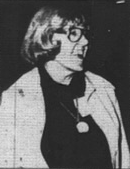
Jane Scott pictured in Rolling Stone, 1979
Jane Scott (1919-2011)’s career as one of America’s most prolific music journalists began with her coverage of the Beatles’ September 15, 1964 concert at Cleveland’s Public Hall. Then a reporter at the Cleveland Plain Dealer for twelve years, she edited both its senior and youth interest columns; the latter, however, was more concerned with hypotheticals than what local young people were truly interested in. “I had the pimples to pension beat, is what my colleagues said,” Scott told Michael Norman. “I gradually switched the emphasis from schooly-dooley stuff to music. When the Beatles appeared on Ed Sullivan’s show, I knew what the kids really wanted to read.”
“She was allowed to take the rock beat because [people at the paper] thought it was trivial at the time, and a woman could have it,” reflects Anastasia Pantsios, who herself helped cement the journalistic slant of the ‘Cleveland rocks’ maxim through her photography. “Most... papers at that time would have sent a columnist, who would have made fun of it and the screaming girls.” Scott, however, took a youth-focused and relentlessly positive approach to reporting, often including the quoted commentary of audience members in her pieces. [One article from later in 1964 even highlights a sourpuss high schooler whose girlfriend is more concerned with her Rolling Stones records than him!] The juxtaposition between the two headlines regarding the Public Hall concert exemplifies the Scott difference: while Kenneth J. Moynihan's read “3,000 Fans Rush Stage, Force Beatles to Retreat”, Scott's read “Mop-Tops Rock — 24,646 Fans Roll”.
Though she never truly understood electronic music, she always kept her ear open to new sounds and sensations, granting small groups the same attention and dignity as stadium-fillers; friends of mine who were kicking around the Cleveland scene in the nineties fondly recall seeing her at DIY venues such as Speak in Tongues. Her declaration of Bruce Springsteen as “the next superstar” in 1975 and early reporting on punk rock — from locals like Peter Laughner to the CBGB-set — are particularly notable. “Jane wasn’t hierarchical or haughty,” notes Death of Samantha singer John Petkovic, writing for the Plain Dealer himself. “She approached music and the people making it with an open mind.”
Many have further noted how Scott’s maternal aura gave her subjects a sense of true comfort they would have likely never recieved elsewhere in the cutthroat rock world; to what other reporter would John Lennon explain his controversial “bigger than Jesus” quip “in a calm, unhurried manner”? (His response? “He was sorry that he said it, ‘the way it turned out.’”) Jim Morrison spoke earnestly to her about religion, while Lou Reed found comfort in her kindness throughout his turbulent solo years. (Says he, “When I was in the Velvet Underground in the sixties” — Cleveland was a second home for them — “Jane was one of the only people I can remember who was nice to us.”) She asked Ringo Starr and Billy Joel about how their families were doing and highlighted John Entwistle’s gardening skills in her report of the Who’s first stateside tour opening for Herman’s Hermits.
“You always felt you were extremely important when Jane was talking to you,” recalls Cleveland rock legend Michael Stanley. “She always gave glowing reviews. Even if she hated something, she could find the good in anything, which is a wonderful, admirable quality.” It is estimated that Scott attended over ten-thousand concerts in her time at the Plain Dealer, which is equivalent to attending one concert a night every night for over twenty-seven years. Even after her retirement in 2002, she remained devoted to keeping Cleveland’s sonic flame alight, attending gigs and even getting local boys the Raspberries to reform for her eightieth birthday. Upon her passing on July 4, 2011 at the age of ninety-two, her personal archive found a new home in the Rock and Roll Hall of Fame; its library has a statue of her with her trusty notepad in hand, ready to interview a new generation of self-made rock-and-roll afficionados. Writes Peter Chakerian, “Several attempts to capture the late Jane Scott’s story in its entirety on film and in book form have been made over the years. To date, none of them have crossed the finish line.” Playwright Majkin Holmquist debuted a work-in-progress script telling her story in 2025, though whether it will reach some degree of larger fruition in the future has yet to be seen.
Her titles included “The Grandmother of Rock” and “The World's Oldest Teenager”.
Click here to read a rare
Rolling Stone article profiling Scott.
Click here to read Scott’s 1967 profile of
Herman’s Hermits, the Who, and the Blues Magoos.
Click here to read articles on the Plain
Dealer’s website about Scott, from which I sourced all of
the information contained in my biography.