Slipping on Betsey Johnson for Paraphernalia
The ‘dollies’ that keep the avant-garde boutiques in business are intrigued with several ideas for the holidays, any one of them guaranteed to make on-lookers stop dead in their tracks. First of all, there’s the thing about lengths — won’t girls in miniskirts four to seven inches above their knees suffer from frostbite? Apparently girls are willing to freeze their thighs in the interest of fashion, because miniskirts are as short as ever. The next fad is for the dress that looks like a slip. Some are so authentically slip-like that no doubt some girls will be asked to go home and come back with their dresses on.— “New Holiday Ideas”, The Philadelphia Inquirer, December 2, 1966
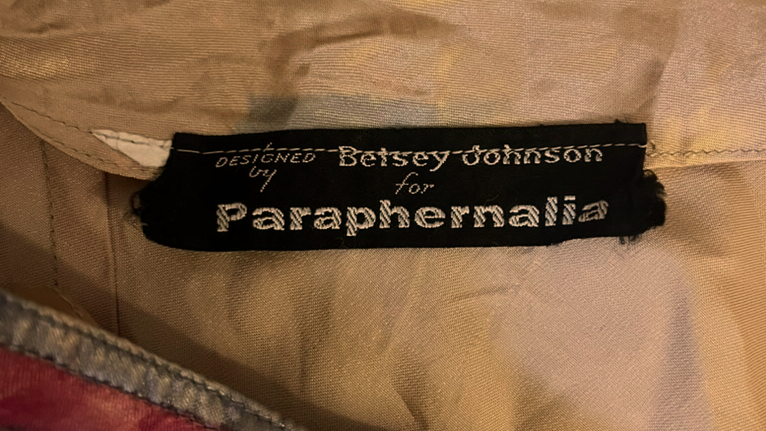
Youth is making a mark in the fashion world. And two most successful of the young designers are Betsey Johnson and John Kloss, both under 30, both uninhibited, both working in New York. [...] Designer Johnson works in a fluorescent forest in Seventh avenue. The walls of her office and the electric blue carpet are charged with electricity. The color everywhere is bright, even to Betsey’s slithery jersey slip-like dress in a fluorescent lettuce green. And the touch of nostalgia is the peach color suede 1930 shoes, which are reminiscent of Eleanor Powell's dancing feet. Betsey’s on a fluorescent kick. She is trying to make everything look like electricity. Basic shapes must follow the body’s natural look. She found fluorescent knits at theatrical fabric houses. She hates vinyl... it's just a hotbox.
Her designs are loaded with spirit, and each makes its own statement. She says Paco Rabanne is the only one in Paris who has created a new concept of fashion. And she can't understand why people are hung up on legs. Locked in a safe, are a whole bunch of Betsey’s 1920 Paris dance hall magazines. These are a big souce of inspiration — as she says the clothes at that time understood the natural lines of the body.
She can’t stand dumb, classic clothes, altho she appreciates quality. This is something the young designers have in common. Things she enjoys are architectural news, the Bauhaus again, and a baby-blue motorcycle that makes lots of noise and smoke. Some of Betsey’s designs can be seen at Paraphernalia here in Chicago when it opens on Friday at 913 N. Rush St.— “Youth is making a mark in the fashion world...”, The Chicago Tribune, August 22, 1966
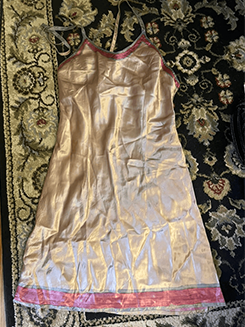
The seller from which I purchased this dress on eBay shared some incredible information about this dress and what sights it might have seen...
My MIL [known as “Dawn”] was a wild, free spirit in the 60s. She earned a massive salary, especially for a single mom, and then turned into a compulsive shopper/hoarder. I inherited 4 large storage units in New Orleans, PACKED with everything you could think of, but mostly clothing, jewelry, and other accessories. Hollywood costumers have purchased at least half (thousands of articles) [...]
While I knew this was a special piece, I know absolutely nothing about it. I’ve never seen any pics of her wearing it (there were thousands of photos, lost in Katrina) nor do I know for sure where she got it.
This was in with a lot of stuff that lines up with her time in Greenwich Village, early to mid sixties. At that time, she was hanging out at the Factory with Andy Warhol, as her housemate was the actress, Ingrid Superstar. This potentially could have belonged to Ingrid, but not likely. Ingrid was very poor, and made most of her clothes. My MIL, on the other hand, was well off, and shopped the high end department stores on 5th Avenue.
I wish I knew more, but as I open the boxes, I am definitely remembering a lot of the stories and photos. I wish both MIL and my beautiful husband were still alive. They lived the wildest adventures, with lots of famous and colorful characters involved.
I should mention that I had Ingrid’s personal journals that she wrote, with lots of entries from the other superstars. She was a strange bird, but so interesting. I sold them to a collector in Sweden.
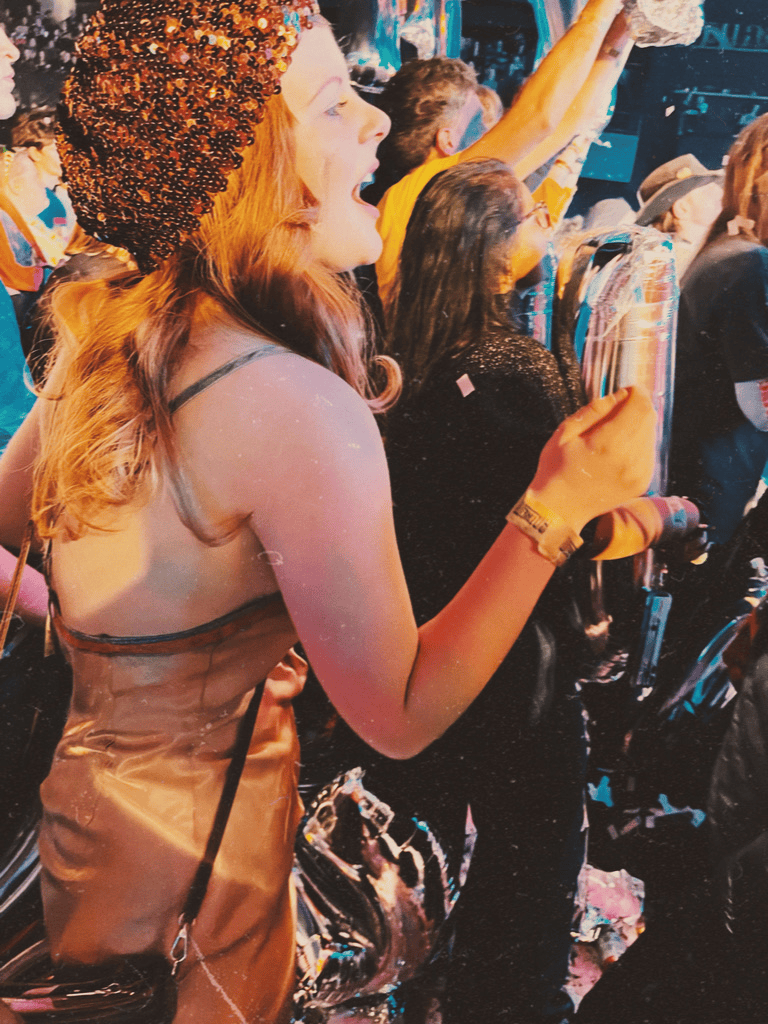
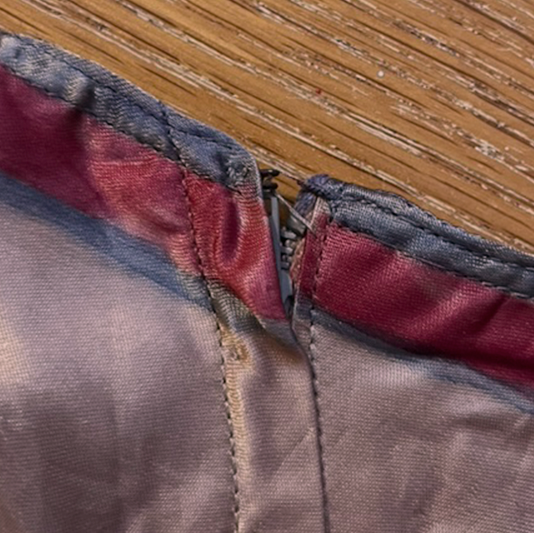
The dress is made of silky soft fabric and features a sturdy side zipper. The fabric is hand-dyed, as evidenced by imperfections throughout the dress and variations in thread pigment. The adjustable straps cross in the back, with each bearing five braided loops which attach to the back with a hook (naturally four of these broke during a Flaming Lips concert).
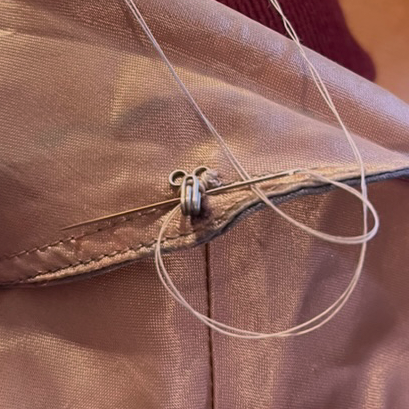
One of the hooks had fallen off and the other strap had been sewn down. Some of the braided loops were also beginning to snap in two. I undid the sewn down strap, reattached both hooks, and replaced the braided loops with simple doubled-up loops of thread. There were also a few gaps forming in the side seams, which I hand-mended, and parts where the hem was coming apart, which I fixed with my machine.
Despite my showcasing of artifacts from 1966, fitting in squarely with Betsey’s Paraphernalia heyday, I am unsure of when this exact dress was produced (and it also ticks off a few boxes of their Fall 1967 line). Nor have I found any photo evidence of it; given the speed of fashion back then, I am not surprised. I am currently researching this garment, but if you are able to unearth anything yourself, please email me!!
✽ ✽ ✽
Clipping quotes sourced using Newspapers.com