|
Activism
Introduction
There are four causes to which I devote much of my free time and resources: (1) Promoting science and reason as offering the most promising and effective solutions to practical and ethical/moral problems in the modern world; (2) Advancing education about evolution and confronting the movement that seeks to include creationism and its variants (e.g., intelligent design) in science curricula; (3) Promoting awareness and knowledge about climate change, the ways in which humans have contributed to climate change, and what we can do to address this critical problem; and, (4) Encouraging greater understanding and appreciation of the natural environment and efforts to preserve wild animals and native plants, especially threatened, vulnerable, and endangered species, in their natural community - an important part of which is calling attention to irresponsible and unethical land and wildlife management practices.
Science and Reason
"The core of science is not controlled experiment or mathematical modeling. It is intellectual honesty. It is time we acknowledged a basic feature of human discourse. When considering the truth of a proposition, one is either engaged in an honest appraisal of the evidence and logical arguments, or one isn't." -Sam Harris
We spend much of our lives trying to convince one another of various claims that we make. On a daily basis, we probably ask ourselves more than once, "Is that true?" For many of the questions that we'll ask in our lives, there is a correct answer. Either it is true that the world's climate is changing, or it is not. If it is changing, either human activity has contributed to the changes, or it has not. Either plant agriculture could feed the world more effectively than livestock farming, or it could not. Either we humans are an evolved species, or we are not.
These, of course, are big, complex questions. But many of us want answers to them. The same goes for the more ordinary questions that we ask in our daily lives. We ask questions, we search for answers, and we want evidence. To paraphrase one of Sam Harris' examples, if I were to tell you that I have a golden refrigerator buried in my backyard, you'd probably immediately ask me to show it to you or otherwise demonstrate how I know that. In other words, you'd ask me for evidence of my claim. If I were to tell you that I don't have to show you the evidence -- that I "just know" that the refrigerator is there; that such a belief simply brings meaning to my life; that I can't imagine a universe where a golden refrigerator is not buried in my backyard -- you'd most likely be pretty disappointed in my response and probably think that I'm crazy. Why? Because I didn't give you evidence of my claim. I am asking you to accept my extraordinary claim without giving you any good reasons for doing so. Would that frustrate you? If so, you're thinking like a scientist.
At a basic level, many (if not all) of us are concerned with "conclusion validity" at some point each day. In simple terms, conclusion validity is "the degree to which the conclusion we reach is credible or believable." Is a claim true? Or is it false? How do we know?
It is sometimes argued by sociologists and others that "science" is just one way of knowing the world. I agree. But I would also argue, as others have, that it is the best available way of knowing the world when it comes to deciding whether a knowledge claim is true or false. So, if a sociologist (or anyone else) is trying to convince you of the truth of some claim and at the same time makes it clear that she or he is dubious of the cientific method (for example, by adhering to a post-modern critique of science), a reasonable question to ask is, "So on what basis, then, should I believe you? Intuition? Faith? My personal emotional reaction to what you're saying? What?" Sometimes these discussions lead to a point where one person is saying, "What's true for you might not be what's true for me," and vice versa. A scientist, of course, cannot operate this way. Imagine a climate scientist who says, "Well, okay, maybe it's just me that sees the climate changing, but I understand how the climate might not be changing for you." It should be obvious to you how pointless and unproductive such "fashionable nonsense" really is. A claim from such a perspective is neither true nor false; it is anything and everything to anyone. In contrast, science does not deal with or permit such cognitive relativism.
So what is science? I suspect that at least some (if not most) of those who have negative things to say about science as a method of knowing do so because they do not really understand what science is or how it works. If you understand that science is principally about intellectual honesty (see quote above), then why would anyone want anything else?
If a scientist makes a claim (e.g., research findings, conclusions), then how does science -- as opposed to something like intuition or commonsense -- help make us "sure" of the claim that is being made. First, science deals with claims the involve procedures and phenomenon that are repeatable. If someone makes a claim about a social phenomenon and then says, "Well, only I have the ability to study this phenomenon," or, "It only happens when I do it or observe it," this is a big red flag for scientists. The beauty of the process of science, then, is that over time it is essentially "self correcting." As the community of scientists responds to reported findings and conclusions by conducting further research on the topic, fact is delineated from fluke/chance findings and fraud.
Furthermore, contrary to popular belief, researchers who behave like scientists are not trying to verify their claims (i.e., show that they are true), rather they conduct research to demonstrate that their claims resist efforts to find them false! Science deals with testable claims, and this strictly means that claims must be falsifiable (Popper 1959, 1969). This does not mean that scientists want to be wrong, it just means that the best test of a claim is an attempt to show that it is false. If scientists make repeated attempts to falsify a claim and they find that they cannot do so, this gives us increasing confidence that the claim is valid. As scientists, we are on the lookout for those who react to falsifications of their claims by saying things along the lines of, "Well, maybe your test didn't come out right, but you must have done something wrong , and I still believe in my heart that I'm right. Nothing will ever change my mind!" There is nothing intellectually honest about that kind of reaction, and the researcher isn't behaving like a scientist. Yet as laypeople we do this sort of thing all the time, and that precisely is what makes things like intuition, gut feelings, commonsense, and personal opinion inferior to the scientific method when it comes to the conclusion validity of claims.
Over time, repeated scientific tests of a claim that withstand attempts at falsification can rise to the status of facts. A fact is an observation that has been repeatedly confirmed and is therefore accepted as "true." Truth in science, however, is never final, and what is accepted as a fact today may be modified or even discarded tomorrow. That is, factual knowledge in science is "provisional." In that sense, science is a dynamic, "living" enterprise. A scientific theory is a well-substantiated explanation of some aspect of the natural world, based on a body of facts that have been repeatedly confirmed through observation. Contrary to popular belief, theories are not mere "hunches" or blind guesses. In science, explanations do not rise to the status of "theory" unless they are supported by mountains of evidence.
I consider myself to be a scientific sociologist. I argue that our work should be geared toward the development and testing of scientific theories, as defined above. Along these lines, I believe that in order to produce meaningful claims (i.e., findings and conclusions whose evaluation is subject to more than our intuition, gut feelings, etc.), these claims must be falsifiable and must deal with repeatable events. Sociology has a number of different types of research designs at its disposal to work toward developing this kind of knowledge. Qualitative designs are especially useful for beginning to develop our understanding of a social phenomenon through induction. Most often they are the starting point for research on a topic. Experimental and survey designs -- especially experimental designs -- are useful for testing knowledge claims and theories built up from qualitative research. Used appropriately and effectively, the different types of research designs available to sociologists help us discover facts and develop theoretical explanations of a wide variety of social phenomena.
For those like me who consider themselves to be scientific sociologists, our goal is the development of good theories. Way back in 1861, in a letter to his friend Henry Fawcett, Charles Darwin pointed out the futility of doing atheoretical research that is purely descriptive:
"[Y]ears ago there was much talk that geologists ought only to observe and not theorize; and I well remember someone saying that at this rate a man might as well go into a gravel pit and count the pebbles and describe the colors. How odd it is that anyone should not see that all observation must be for or against some view if it is to be of any service!"
Some of those doing work in sociology today could benefit, I believe, from reflecting on these words. If they did so, the knowledge we produce would be more universally useful. Believing that, part of my activist agenda (as summarized above), involves convincing my colleagues and future generations of sociologists that it is worthwhile for sociology to become more (not less) scientific.
Scientific Literacy. A second component of my activism concerning science and reason focuses on the crisis of scientific literacy in the United States. In an age of slowly increasing scientific literacy where young adults are showing increasing support for scientific theories (e.g., evolution), beliefs in pseudoscience (e.g., that UFOs are spacecraft from other planets) have not dropped off with the modest rise in scientific literacy. Indeed, from the standpoint of what science tells us, people believe all sorts of bizarre things. For example, many people believe that the Earth is only several thousand years old. Yet geologists and geophysicists using 40 or so different methods of radiometric dating that have been refined over the last 50+ years have determined from samples of meteorites and the oldest known terrestrial and lunar samples that the earth is about 4.5 billion years old. Thus the Earth is actually 750,000 times older than some people think! That error is comparable to believing that our Declaration of Independence (actually adopted over 230 years ago on July 4, 1776) was signed just about 3 hours ago.
While slowly improving, levels of factual knowledge of science in the U.S. and Americans' understanding of the scientific process are still quite low (see the National Science Foundation's most recent biennial report on the state of science and engineering research and education in the United States). Why?
As argued by Paul Bloom and Skolnick Weisberg, the problem with teaching science is 'not what the student lacks, but what the student has, namely alternative conceptual frameworks for understanding phenomena covered by the theories [that scientists] are trying to teach' (Carey 2000, cited in Bloom & Weisberg 2007:996; emphasis in original). That is, Bloom and Weisberg argue that all of us are born with "foundational biases"-- i.e., our brains want to see the world in certain ways, ways that conflict with what science tells us, thereby making it more difficult for us to accept science. Kids, for example, tend to naturally see the world in terms of design and purpose, a fact that gives Creationism a certain advantage. Kids also have a difficult time linking the brain to many aspects of mental life, including emotions, beliefs, and desires. Plus, in terms of conflicting claims regarding knowledge that cannot be ascertained by direct experience (e.g., evidence of macro evolution), we tend to evaluate the source and not the claim itself -- i.e., who is trustworthy? We tend to side with parents and trusted religious and political leaders who may not accept what science has to say about a given topic, such as evolution.
Furthermore, with respect to the observation that pseudoscientific beliefs have not dropped off with the modest rise in scientific literacy, Eve argues that a likely reason for this is that most teachers do not address pseudoscientific beliefs and topics in the classroom: "[W]hen such topics are not dealt with in the classroom the mass media are likely to fill the gaps -- often with unfortunate results" (Eve, p. 15). "Monster Quest," for example, is a documentary television series that began to air on October 31, 2007 on The History Channel. The program seems to assign as much (if not more) credibility to pseudoscience than science in its search for various cryptozoological creatures reportedly seen around the world.
Developing students' understanding of the scientific process, their scientific literacy, and their reasoning ability is a point of emphasis in almost all of my classes. A good and even fun place to start is to try and develop one's understanding of logical fallacies. Once you've done so, try listening to your favorite radio and/or television host for a few hours as she or he tries to convince you of one claim or another. See if you can identify the fallacies present in the host's arguments and count them up. You'll probably be shocked by what you find. And if you then consider that the average person listening to the program will not pick up on the fallacies you've identfied, you'll probably be even more shocked.
Evolution
My nephew Danny put it best when he said, "Evolution is not something to be believed, it is something to be understood."
[more coming soon...]
Climate Change
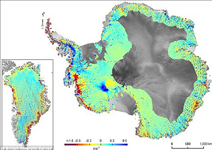 Climate change is another one of those touchy subjects that, unfortunately, many people approach as a matter of opinion: "Well, I don't think the climate is changing. Even if it is, I don't think humans had anything to do with it. That's just my opinion." Yet there are, in fact, right and wrong answers to questions concerning climate change. Thinking this way is what it means to be a scientist. Either the world's climate is changing, or it is not. Either humans have contibuted to any climate change that may be occurring, or they have not. Either talk about climate is all a big hoax, or it is not. From what I have observed, climate change is an issue that people know very little about, yet they tend to have very strong opinions in one direction or the other. These opinions oftentimes seem to reflect the fallacy of "wishful thinking." Climate change is another one of those touchy subjects that, unfortunately, many people approach as a matter of opinion: "Well, I don't think the climate is changing. Even if it is, I don't think humans had anything to do with it. That's just my opinion." Yet there are, in fact, right and wrong answers to questions concerning climate change. Thinking this way is what it means to be a scientist. Either the world's climate is changing, or it is not. Either humans have contibuted to any climate change that may be occurring, or they have not. Either talk about climate is all a big hoax, or it is not. From what I have observed, climate change is an issue that people know very little about, yet they tend to have very strong opinions in one direction or the other. These opinions oftentimes seem to reflect the fallacy of "wishful thinking."
Because issues surrounding climate change are critical for human survival, I believe that all of us have an obligation to make time to become students of climate change and related matters such as population dynamics and agroecology. In other words, given the importance of the matter, I personally think it is irresponsible for people to ignore the topic or have strong opinions about the topic without being well informed.
Of course, if you Google "climate change," I can see how you might become immediately frustrated by how many hits are returned: "There's just too much information! Where do I start?" I think an excellent introduction to the topic is provided in a 22-page summary report prepared by the National Academy of Sciences. The report is entitled "Understanding and Responding to Climate Change: Highlights of National Academies Reports." If you'd like to read it, please click here.
Based on the wealth of scientific information that I have reviewed carefully (including the NAS report), I am persuaded by the evidence showing that climate change is occurring, that humans have contributed to producing the climate changes we are now observing, and these changes constitute a crisis that demands immediate governmental and personal action.
I think Christopher Hitchens also takes an interesting position on the question of climate change:
"The argument about global warming is not whether there is any warming, but whether or not and to what extent human activity is responsible for it. My line on that is that we should act as if it is...So if it turned out to be that there was no severe global warming threat or that it wasn't man-made, then all we would have done would be make a mistake in analysis -- which we could correct from. But if it turned out that there was and we didn't do anything about it, then it would be too late to do anything at all. And that would lead to disaster."
Wildlife
 I am a member of Defenders of Wildlife and an avid outdoor enthusiast. You probably got that sense if you browsed through the images on my homepage. I am a member of Defenders of Wildlife and an avid outdoor enthusiast. You probably got that sense if you browsed through the images on my homepage.
During a wildlife debate, someone once said to me, "Animals are below us on the food chain for a reason, TO BE EATEN. They're not here on this earth to be looked at" (emphasis in original typed message). I was not surprised to later find out that this person is a butcher by occupation. I can imagine that it would be difficult to be a butcher and have a view other than the one he expressed, but that doesn't make the view ethical.
During the same debate it was argued by another person that people all over the world eat meat, so that, in effect, makes it okay. This person was actually making a two-pronged argument: (1) Too many people like to eat meat and/or rely on it as a source of food, and you'll never, therefore, change all of their minds, and (2) The fact that a "super majority" of humans are meat-eaters means that the practice is ethical. The second line of argument is a logical fallacy, and so it is immediately defeated as an ethical guideline. The first line of argument sets up a more difficult challenge, and much of my activism when it comes to wildlife is devoted to changing people's minds about eating meat. The gist of my argument is as follows:
[more coming soon...]
|

