Research

What We Study

From fundamental liquid crystal physics to soft robotics, wearable sensing, energy, and tunable optics. Expand "Related publications" under each topic for key papers.

Ferroelectric Nematic Liquid Crystals

The recently discovered ferroelectric nematic (NF) phase combines giant spontaneous polarization (over 0.04 C/m²) and enormous dielectric constants with sub-millisecond switching — opening applications in high-power supercapacitors and low-voltage, fast electro-optical devices. In chiral-doped mixtures, the selective reflection color can be reversibly tuned by very small in-plane fields (0.02–0.1 V/µm), enabling backlight-free displays, smart windows, shutters, and e-papers.

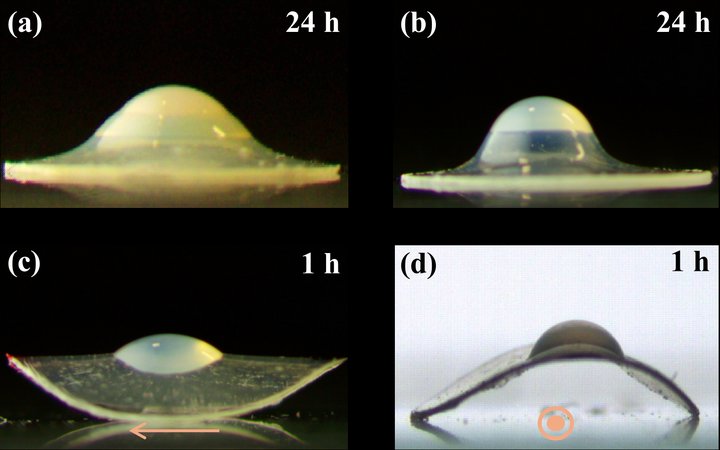
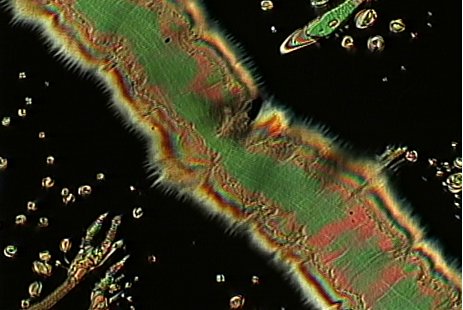
We also explore the rich fluid behaviour of the NF phase: pancake-shaped droplets that drift and deform in weak electric fields, sessile drops and fluid bridges that show fingering instabilities, thermally driven "thermo-motors," and freestanding ferroelectric filaments stabilized by fields three orders of magnitude smaller than in ordinary dielectric fluids.

The same giant polarization makes the NF phase intrinsically piezoelectric: mechanical strain couples linearly to polarization, giving a fluid material that converts between mechanical and electrical energy — a "liquid piezoelectric" effect with no solid-state analogue.

Related publications (27)
  • Printable Bifocal Microlenses from Ferroelectric Nematic Liquid Crystal Droplets
    M. Talwar, Z. Siddiquee, A. Jákli
    ACS Applied Materials & Interfaces, 2026
  • Selective Reflection of Chiral Ferroelectric Nematic Liquid Crystals Tuned by Electric Field Along the Helix Axis
    M. S. H. Himel, R. Dharmarathna, J. T. Gleeson, R. J. Twieg, S. Sprunt, A. Jákli
    Advanced Optical Materials, 2026
  • Low-Power Temperature Control by Chiral Ferroelectric Nematic Liquid Crystal Windows
    M. S. H. Himel, R. Dharmarathna, N. P. Dhakal, K. Perera, S. Sprunt, J. T. Gleeson, et al.
    Laser & Photonics Reviews, 20(9), 2026
  • Ferroelectric nematic phase at a photosensitive polymer substrate: comparing thermo-mechanical effect with photo-reorientation
    T. Tóth-Katona, A. R. K. Nassrah, P. Salamon, A. Jákli, I. Jánossy
    Journal of Molecular Liquids, 2026
  • Transient negative capacitance in ferroelectric and twist-bend ferroelectric nematic liquid crystals
    N. P. Dhakal, M. Talwar, Z. Siddiquee, J. Karcz, P. Kula, P. Salamon, A. Jákli
    Soft Matter, 2026
  • Electrically tunable chiral ferroelectric nematic liquid crystal reflectors
    M. S. H. Himel, K. Perera, A. Adaka, P. Guragain, R. J. Twieg, S. Sprunt, A. Jákli
    Advanced Functional Materials, 35(3), 2025
  • Ferroelectric nematic and smectic liquid crystals with sub-molecular spatial correlations
    P. Guragain, A. Ghimire, M. Badu, N. P. Dhakal, P. Nepal, J. T. Gleeson, … A. Jákli
    Materials Horizons, 12(19), 2025
  • Light-induced thermomechanical reorientation and helicity flipping in ferroelectric nematic phase
    T. Tóth-Katona, I. Jánossy, P. Salamon, A. Jákli
    Communications Materials, 6(1), 2025
  • Transient negative capacitance in ferroelectric nematic liquid crystals
    N. P. Dhakal, A. Adaka, R. J. Twieg, N. A. Clark, A. Jákli
    Physical Review Applied, 24(1), 2025
  • Dynamics of the antiferroelectric smectic-ZA phase in a ferroelectric nematic liquid crystal
    A. Ghimire, B. Basnet, H. Wang, P. Guragain, A. Baldwin, R. Twieg, … A. Jákli
    Soft Matter, 21(44), 2025
  • Low field electrocaloric effect at isotropic–ferroelectric nematic phase transition
    A. Adaka, P. Guragain, K. Perera, P. Nepal, R. J. Twieg, A. Jákli
    Soft Matter, 21(3), 2025
  • Reorientation of ferroelectric nematic liquid crystals under out-of-plane electric and magnetic fields
    M. T. Mathé, N. Éber, Á. Buka, H. Nishikawa, F. Araoka, A. Jákli, P. Salamon
    Journal of Molecular Liquids, 428, 2025
  • Comprehensive Characterization of a Reference Ferroelectric Nematic Liquid Crystal Material
    A. Paul, M. Paul, M. Badu, A. Ghimire, N. P. Dhakal, S. Sprunt, A. Jákli, et al.
    Materials, 18(24), 2025
  • Electrically Activated Ferroelectric Nematic Microrobots
    M. T. Máthé, H. Nishikawa, F. Araoka, A. Jákli, P. Salamon
    Nature Communications, 15, 2024
  • Dielectric Properties of a Ferroelectric Nematic Material
    A. Adaka, M. Rajabi, N. Haputhantrige, S. Sprunt, O. D. Lavrentovich, A. Jákli
    Physical Review Letters, 2024
  • Electrically Tunable Polymer Stabilized Chiral Ferroelectric Nematic Liquid Crystal Microlenses
    K. Perera, N. Haputhantrige, M. S. H. Himel, M. Mostafa, A. Adaka, E. K. Mann, … A. Jákli
    Advanced Optical Materials, 2024
  • Self-Assembled Biconvex Microlens Array Using Chiral Ferroelectric Nematic Liquid Crystals
    K. Perera, A. Alyami, A. Adaka, … A. Jákli
    Advanced Optical Materials, 2024
  • Ramification and Labyrinth Instabilities in a Ferroelectric Nematic Fluid Exposed to Electric Fields
    M. T. Máthé, H. Nishikawa, F. Araoka, A. Jákli, P. Salamon
    Journal of Molecular Liquids, 2024
  • A Ferroelectric Nematic Liquid Crystal Vitrified at Room Temperature
    A. Adaka, P. Guragain, K. Perera, … A. Jákli
    Liquid Crystals, 2024
  • From solid to liquid piezoelectric materials
    M. Gill, M. T. Mathé, P. Salamon, J. T. Gleeson, A. Jákli
    Materials Horizons, 12(21), 2025
  • Liquid Piezoelectric Materials: Linear Electromechanical Effect in Fluid Ferroelectric Nematic Liquid Crystals
    M. T. Máthé, M. S. H. Himel, A. Adaka, J. T. Gleeson, S. Sprunt, P. Salamon, A. Jákli
    Advanced Functional Materials, 2024
  • Fluid ferroelectric filaments
    M. T. Máthé, K. Perera, Á. Buka, P. Salamon, A. Jákli
    arXiv:2307.16588
  • Electric field-induced interfacial instability in a ferroelectric nematic liquid crystal
    M. T. Máthé, B. Farkas, L. Péter, Á. Buka, A. Jákli, P. Salamon
    Scientific Reports, 13:6981, 2023
  • Ferroelectric Nematic Droplets in their Isotropic Melt
    K. Perera, R. Saha, P. Nepal, R. Dharmarathna, M. S. Hossain, M. Mostafa, A. Adaka, R. Waroquet, R. J. Twieg, A. Jákli
    Soft Matter, 19, 347–354, 2023
  • Ferroelectric nematic liquid crystal thermo-motor
    M. T. Máthé, Á. Buka, A. Jákli, P. Salamon
    Physical Review E, 105, L052701, 2022
  • Multiple ferroelectric nematic phases of a highly polar liquid crystal compound
    R. Saha, P. Nepal, C. Feng, M. S. Hossein, J. T. Gleeson, S. Sprunt, R. J. Twieg, A. Jákli
    Liquid Crystals, 49(13), 1784–1796, 2021
  • Electrically Tunable Reflection Color of Chiral Ferroelectric Nematic Liquid Crystals
    C. Feng, R. Saha, E. Korblova, D. Walba, S. N. Sprunt, A. Jákli
    Advanced Optical Materials, 2101230, 2021
Ionic liquid crystal elastomer

Electro-Active Ionic Elastomers

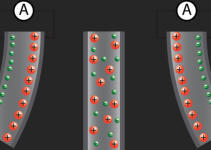
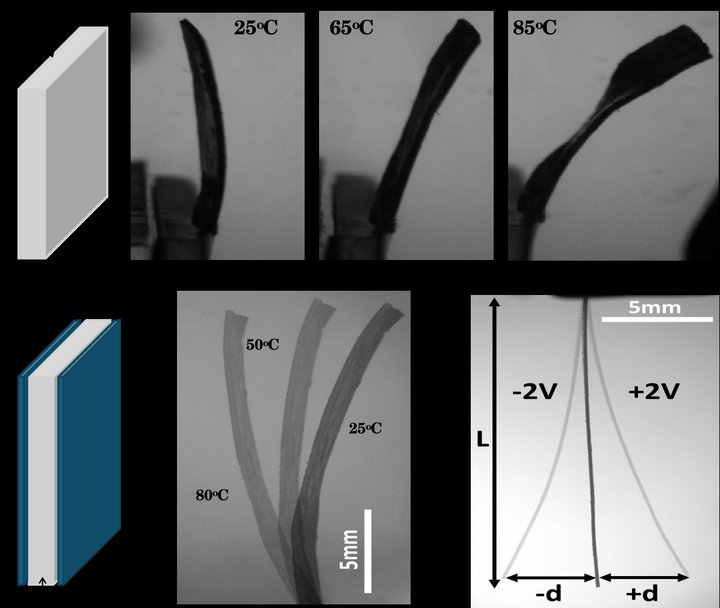
Motivated by the low-voltage actuation of ionic electroactive polymers, we develop ionic elastomers — ionic polymer electrolyte membranes (iPEM) and ionic liquid crystal elastomers (iLCE) — that bend under AC or DC voltages below 1 V. Our iPEMs outperform most well-developed ionic EAPs, while even un-optimized iLCEs are already comparable.

Ionic liquid crystal elastomers add a unique advantage: alignment-dependent actuation, which allows actuation patterns to be pre-programmed during cross-linking. Thermal, optical, and electric actuation are all possible. We also study compliant electrodes and soft-robotic applications.

Related publications (2)
  • Poly(ethylene glycol) Diacrylate Based Electro-Active Ionic Elastomer
    C. P. H. Rajapaksha, C. Feng, C. Piedrahita, J. Cao, V. Kaphle, B. Lüssem, T. Kyu, A. Jákli
    Macromolecular Rapid Communications, 41, 1900636, 2020
  • Electro-responsive Ionic Liquid Crystal Elastomers
    C. Feng, C. P. H. Rajapaksha, J. M. Cedillo, C. Piedrahita, J. Cao, V. Kaphle, B. Lüssem, T. Kyu, A. I. Jákli
    Macromolecular Rapid Communications, 1900299, 2019
Flexo-ionic effect in ionic liquid crystal elastomers

Flexo-Ionic Effect of Ionic Liquid Crystal Elastomers

Flexoelectricity couples electric polarization to a strain gradient, studied in both crystals and liquid crystals since the 1960s. A related but much larger effect arises in ionic materials, where the polarization comes from the displacement of differently sized cations and anions — yielding very large flexo-ionic coefficients (29–323 µC/m).

Such a large response is promising for soft robotics, sensors, and micro power generation. We study the flexo-ionic effect in a new class of ionic liquid crystal elastomers, characterizing elastic modulus, phase transitions, ionic conductivity, and morphology, and how molecular alignment controls the flexo-ionic coefficients.

Related publications (4)
  • Role of Cationic Size and Valency in Mechanoelectrical Transduction of Ion-Containing Polymers
    H. A. Albehaijan, J. Cao, C. R. Piedrahita, A. Jákli, T. Kyu
    ACS Sustainable Chemistry & Engineering, 9, 1837–1845, 2021
  • Flexoelectricity in Flexoionic Polymer Electrolyte Membranes: Effect of Thiosiloxane Modification on PEG Diacrylate and Ionic Liquid Electrolyte Composites
    C. R. Piedrahita, P. Yue, J. Cao, H. Lee, C. P. Rajapaksha, C. Feng, A. Jákli, T. Kyu
    ACS Applied Materials & Interfaces, 12, 16978–16986, 2020
  • Mechanoelectrical Transduction of Polymer Electrolyte Membranes: Effect of Branched Networks
    H. A. Albehaijan, C. R. Piedrahita, J. Cao, M. Soliman, S. Mitra, T. Kyu
    ACS Applied Materials & Interfaces, 12, 7518–7528, 2020
  • Poly(ethylene glycol) Diacrylate Based Electro-Active Ionic Elastomer
    C. P. H. Rajapaksha, C. Feng, C. Piedrahita, J. Cao, V. Kaphle, B. Lüssem, T. Kyu, A. Jákli
    Macromolecular Rapid Communications, 41, 1900636, 2020

Liquid Crystal Elastomer Mechanics

Beyond electrical and ionic actuation, we study how liquid crystals reshape the mechanical properties of the elastomer networks that contain them. Dispersing low-molecular-weight liquid crystal inclusions into an elastomer matrix can dramatically stiffen the network, while swelling a liquid crystal elastomer with a low-molecular-weight liquid crystal solvent drives controlled, reversible shape changes.

These effects let us tune stiffness and shape independently of chemical cross-linking density, opening routes to soft actuators and structural materials whose mechanical response is programmed by the liquid crystal phase itself rather than by the polymer backbone alone.

Related publications (2)
  • Stiffening Liquid Crystal Elastomers with Liquid Crystal Inclusions
    S. Vasanji, M. G. Scarfo, A. Alyami, T. H. Mekonnen, P. Hajireza, M. O. Saed, et al., A. Jákli
    Advanced Materials, 37(45), 2025
  • Shape Changes of Liquid Crystal Elastomers Swollen by Low Molecular Weight Liquid Crystal Drops
    M. Kodithuwakku Arachchige, R. Dharmarathna, P. Fleischer, A. Jákli
    Macromolecular Rapid Communications, 46(15), 2500178, 2025
Liquid crystal microlens arrays

Microlens Arrays

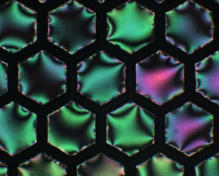
Liquid-crystal-based microlens arrays have attractive applications in optoelectronics, integrated optics, optical fiber switches, information processing, optical communications, and imaging. Most existing LC microlens arrays require delicate fabrication.

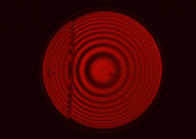
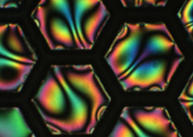
We study cholesteric liquid crystal microlens arrays in different configurations that show unique geometrical and optical properties, focusing on simple, cost-effective fabrication using different cholesteric mixtures and on the optical capabilities of the lenses for a range of applications.

Related publications (3)
  • Electrically tunable chiral liquid crystal lens arrays
    K. Perera, N. Haputhantrige, M. S. H. Himel, M. Mostafa, A. Adaka, O. D. Lavrentovich, A. Jákli
    SPIE 12658-30, 2023
  • Polymer Stabilized Paraboloid Liquid Crystal Microlenses with Integrated Pancharatnam–Berry Phase
    K. Perera, H. N. Padmini, E. Mann, A. Jákli
    Advanced Optical Materials, 2101510, 2021
  • Converging microlens array using nematic liquid crystals doped with chiral nanoparticles
    K. Perera, A. Nemati, E. Mann, T. Hegmann, A. Jákli
    ACS Applied Materials & Interfaces, 13, 4574–4582, 2021 · Cover
Liquid crystal spherical caps in fields

LC Spherical Caps in Magnetic & Electric Fields

We study, experimentally and theoretically, the director structure of nematic liquid crystal drops forming spherical caps under magnetic and electric fields, starting from a director perpendicular to the air and glass boundaries. Above a threshold field a metastable inversion wall forms in the middle of the drop and then moves outward; under high-frequency (>120 Hz) electric fields the defect wall rotates parallel to the field.

The linear displacement of the field-induced defect wall, together with the deformation threshold, lets us determine both the bend elastic constant and the rotational viscosity. Drops with uniform director structure can act as tunable optical lenses whose focal length is controlled by light polarization, viewing angle, and magnetic or electric fields.

Related publications (5)
  • Nematic liquid crystals in lens shape geometry
    Á. Buka, P. Salamon, M. Máthé, Z. Karaszi, A. Jákli
    Liquid Crystals (Invited), 2023
  • Electric field induced buckling of inversion walls in lens-shape liquid crystal droplets
    Z. Karaszi, M. Máthé, P. Salamon, Á. Buka, A. Jákli
    Journal of Molecular Liquids, 365, 120177, 2022
  • Lens-shaped nematic liquid crystal droplets with negative dielectric anisotropy in electric and magnetic fields
    Z. Karaszi, M. Máthé, P. Salamon, Á. Buka, A. Jákli
    Liquid Crystals, 2022
  • Lens shape liquid crystals in electric fields
    Z. Karaszi, P. Salamon, Á. Buka, A. Jákli
    Journal of Molecular Liquids, 334, 116085, 2021
  • Liquid crystal spherical caps in magnetic fields
    P. Salamon, Z. Karaszi, V. Kenderesi, Á. Buka, A. Jákli
    Physical Review Research, 2, 023261, 2020

Energy Storage & Electrochemical Devices

Ionic liquid crystal elastomers are also excellent solid electrolytes: their ordered ion channels support fast ion transport while remaining mechanically robust. We use them as gel-polymer electrolytes for lithium-ion batteries, where molecular alignment improves ionic conductivity and cycling stability over conventional disordered polymer electrolytes.

The same ionic liquid crystal elastomer electrolytes work as the solid electrolyte layer in organic electrochemical transistors (OECTs), enabling flexible bending sensors and structural-health-monitoring composites. We also study electrocaloric effects at ferroelectric and antiferroelectric phase transitions in bent-core and ferroelectric nematic liquid crystals for high-power capacitors and solid-state cooling.

Related publications (8)
  • Harnessing Anisotropy in Liquid Crystal Elastomer based Lithium-Ion Gel-Polymer Batteries
    Z. Siddiquee, W. Xu, A. Jákli
    RSC Advances, 15(55), 47066–47080, 2025
  • Plasticized Ionic Liquid Crystal Elastomer Emulsion-Based Polymer Electrolyte for Lithium-Ion Batteries
    Z. Siddiquee, H. Lee, W. Xu, T. Kyu, A. Jákli
    Batteries, 11(3), 106, 2025
  • Integration of Organic-Electrochemical Transistors into Composite Material for Structural Health Monitoring
    S. Bornemann, C. Polle, S. Bosse, D. May, M. Skowrons, A. Jákli, B. Lüssem
    Procedia Computer Science, 276, 2026
  • Performance of Organic Electrochemical Transistors with Ionic Liquid Crystal Elastomers as Solid Electrolytes
    A. Alyami, M. Skowrons, K. Perera, B. Lüssem, A. Jákli
    ACS Applied Materials & Interfaces, 2024
  • Bending Sensor Using Ionic Liquid Crystal Elastomers as Solid Electrolyte of Organic Electrochemical Transistors
    A. Alyami, C. P. H. Rajapaksha, P. R. Paudel, V. Kaphle, S. G. Kodikara, et al.
    Liquid Crystals, 2024
  • Ionic Liquid Crystal Elastomers Based Flexible Organic Electrochemical Transistors: Effect of director alignment of the solid electrolyte
    C. P. H. Rajapaksha, P. R. Paudel, P. M. S. G. Kodikara, D. Dahal, T. M. Dassanayake, V. Kaphle, B. Lüssem, A. Jákli
    Applied Physics Reviews, 9, 011415, 2022
  • Low field electrocaloric effect at isotropic–ferroelectric nematic phase transition
    A. Adaka, P. Guragain, K. Perera, P. Nepal, R. J. Twieg, A. Jákli
    Soft Matter, 21(3), 2025
  • Antiferroelectric bent-core liquid crystal for possible high-power capacitors and electrocaloric devices
    R. Saha, C. Feng, A. Eremin, A. Jákli
    Crystals, 10, 652, 2020
Responsive liquid crystal / polymer fibers

Responsive Liquid Crystal / Polymer Fibers

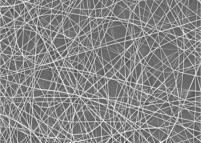
Using airbrushing, electrospinning, and force spinning of homogeneous LC/polymer solutions, we make piezoelectric and responsive composite fibers. Quantitative measurements show that vapors such as toluene and acetone pass through the polymer sheath and are absorbed by the liquid crystal in the core, changing the fiber mat's optical properties — enabling sensitive, reversible detection of volatile organic compounds.

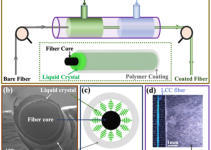
A simple process clads conventional monofilament fibers with low-molecular-weight liquid crystals stabilized by an outer polymer sheath. These fibers keep the responsiveness of the LC in a flexible, drapable format, and the monofilament core makes them far more rugged, with a magnified response to external stimuli. Their sensitivity can be tuned by varying the liquid crystal composition.

Related publications (2)
  • Colloidal Latex / Liquid Crystal Coatings for Thermochromic Textiles
    M. Mostafa, D. M. Agra-Kooijman, K. Perera, A. Adaka, J. L. West, A. Jákli
    Colloid and Interface Science Communications, 52, 100693, 2023
  • Responsive Liquid-Crystal-Clad Fibers for Advanced Textiles and Wearable Sensors
    Y. Guan, D. M. Agra-Kooijman, S. Fu, A. Jákli, J. L. West
    Advanced Materials, 1902168, 2019
Textiles and wearable sensors

Textiles & Wearable Sensors

Building on our liquid-crystal-clad monofilament fibers, we develop fabrics that retain the responsive properties of liquid crystals in a flexible, drapable format. The monofilament core makes the fibers rugged with a magnified response to external stimuli compared to earlier electrospun or airbrushed LC-core fibers.

The sensitivity of individual fibers can be tuned over a broad range by varying the liquid crystal composition. Complex fabrics can be woven from fibers that respond to temperature, chemical concentration, and pressure — and fashioned into garments that sense and report the wearer's health or environment.

Related publications (2)
  • Liquid Crystal Coated Yarns for Thermo-Responsive Textile Structures
    D. M. Agra-Kooijman, M. Mostafa, M. Krifa, L. Ohrn-McDaniel, J. L. West, A. Jákli
    Fibers, 11, 3, 2023
  • Responsive Liquid-Crystal-Clad Fibers for Advanced Textiles and Wearable Sensors
    Y. Guan, D. M. Agra-Kooijman, S. Fu, A. Jákli, J. L. West
    Advanced Materials, 1902168, 2019
Biological sensing with liquid crystals

Biological Sensing with Liquid Crystals

Liquid-crystal-based biosensors exploit the high sensitivity of liquid-crystal alignment to amphiphiles adsorbed onto an LC surface from water. They offer inexpensive, easy optical detection of biologically relevant molecules such as lipids, proteins, and cells.

The techniques use linear or circular polarizers to read out the alignment of the liquid crystal, translating molecular binding events into clear optical signals — and we have demonstrated antigen detection with sensitivity comparable to ELISA.

Related publications (1)
  • Liquid Crystal-based Detection of Antigens with ELISA Sensitivity
    K. Perera, T. M. Dassanayake, M. Jeewanthi, H. N. Padmini, S. D. Huang, E. Kooijman, E. Mann, A. Jákli
    Advanced Materials Interfaces, 2200891, 2022