Scientific Method (GEOL 4/5/72035)

An introduction to quantitative methods for earth scientists

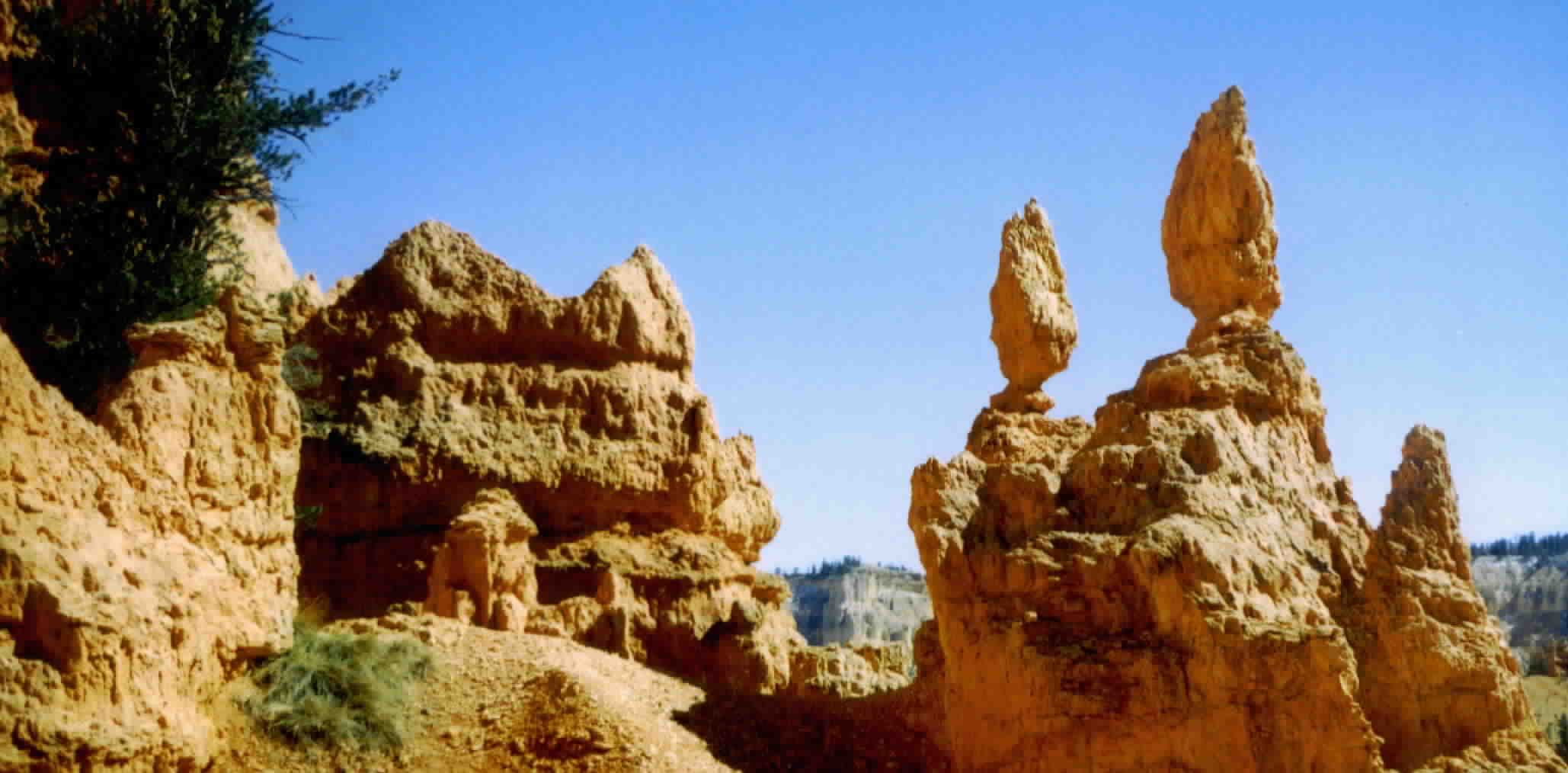
Hoodoos along the trail to Victoria's Garden, Bryce Canyon , UT
Photograph copyright 1999,  Joseph D. Ortiz


Instructor:
Email:
Web:
Dr. Joseph D. Ortiz (About the instructor)
jortiz@kent.edu
www.personal.kent.edu/~jortiz/home
Phone:  330-672-2225


Office and Lab:
Mailbox:
McGilvrey Hall, Room 334/336
Dept. of Geology Office, 
McGilvrey Hall, Room 221
 FAX:  330-672-7949
Office Hours for Dr. Ortiz
McGilvrey Hall
Room 334/336
Monday    10:00    -   11:30 am
Thursday    3:20    -     4:30 pm

or by appointment

Course Rationale and Objectives: Students graduating from college today face an increasingly technical and computer oriented society that demands a quantitatively skilled work force. This is especially true within the fields of math and science. This upper level course will provide participants with a broad introduction to quantitative and statistical methods commonly used by research scientists. This objective will be accomplished through lectures, selected readings from the primary literature, and computer exercises built around existing climate and environmental data sets. Emphasis will be placed on developing an understanding of the concepts underlying various methods and gaining the insights needed to determine which tests are appropriate for a particular application or data set.

Approach: An important aspect of the course will be the "hands on" computational experience working with real world data sets on personal computers using a variety of software applications. Students will be encouraged to use their own data sets or data sets provided by their advisor for the final project. Working with real world data will help to give immediate relevance to the examples presented in class and on laboratory assignments. The internet provides an excellent source of data that will be appealing to students with broad academic interests (see below).

Expected outcome: Participants will gain an appreciation for statistical methods and considerable experience working with computational software as research tools. This will allow them to develop quantitative skills that will be helpful in a wide variety of potential career choices.

Pre-requisites: Basic computer skills, Algebra, and once semester of Calculus and/or Linear Algebra will be helpful. Experience with computational software helpful by not required. Enrollment will be limited, interested students should contact the instructor for permission.

Text: Mathematics, A simple tool for Geologists, 2nd Edition by David Waltham, ISBN 0-632-05345-3

Class resources University resources
Download Class Syllabus

Course Topics and Readings

Grading

Accommodations for Students with Special Needs

Kent State University Helpdesk

Academic Calendar

Academic Counseling Resources for Students

KSU Library Website

Electronic Learning Resources Data Analysis and Statistical Software
Lecture Notes on Statistical Methods

Basic Statistical Relationships

A simple unix cheat sheet

A short glossary of linear algebra terms

Quantitative Methods bibliography

StatSoft Electronic Textbook  

Dr. Prothero (UCSB) Introduction to Geological Data Analysis

Rice University Virtual Statistics Lab


USNA Department of Chemistry Online Excel Tutor

Singular Spectrum Analysis-Multi-Taper Method SSA-MTM Toolkit

Matlab Central

IDL User Contributed Library

CRAN- the R Homepage - Data Visualization and Analysis Language

Listing of Statistical Freeware and Shareware

StatSci Free Statistical Software List

NOAA Paleoclimate Software Library


Class Assignments

Instructions for obtaining the files: Follow the links below to the data directory, 
then download the material you will need to complete the assignments.

Univariate and Bivariate Methods

Multivariate Methods

Time Series Analysis

No. 1: Intro to Excel No.  5:  Analysis of Variance (ANOVA) No.   9: TSA, Part 1
No. 2: Probability and Sampling No.  6: Multiple Linear Regression No. 10: TSA, Part 2
No. 3: Correlation and T-Test No.  7: Discriminant Function Analysis No. 11: TSA, Part 3
No. 4: Linear Regression No.  8: Factor Analysis No. 12: Presentation of 
Class Projects

Potential sources of data on the web:


Climate, paleoclimate, and geology:  
  IRI/LDEO Climate Library  http://ingrid.ldgo.columbia.edu/
  NOAA World Data Center A  http://www.ngdc.noaa.gov/paleo/
  CODIAC  http://www.ofps.ucar.edu/codiac/
  NASA/GISS  http://www.giss.nasa.gov/
  Pangea http://www.pangaea.de/Info/
   
Oceanographic:  
  JGOFS  http://www1.whoi.edu/jg/dir/jgofs/
  WOCE  http://oceanic.cms.udel.edu/woce/
  GOS http://www.gos.udel.edu/
   National Buoy Data Center http://www.ndbc.noaa.gov/
  The ARGO Project http://www.argo.ucsd.edu/index.html
   
Environmental:  
  US EPA  http://www.epa.gov/epahome/Data.html
  North Carolina Environ. Education  http://www.enr.state.nc.us/html/data.html
  Florida Dept. of Environ. Protection  http://www.dep.state.fl.us/beaches/
  City of Tucson, Water Department http://www.ci.tucson.az.us/water/detailed_wq_data.htm


Kent State University Home Page
KSU Department of Geology
Homepage for Dr. J.D. Ortiz
Acknowledgments